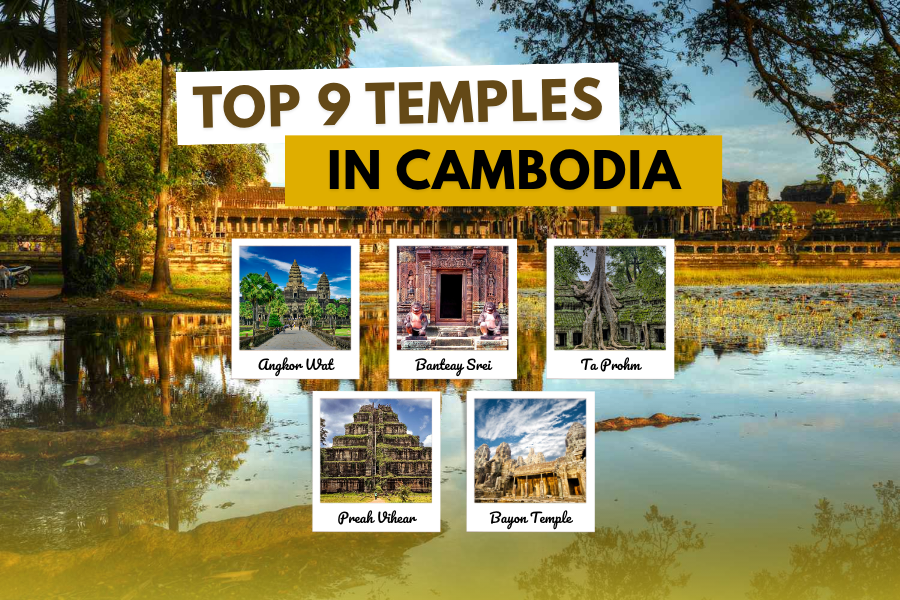
Exploring the best temples in Cambodia is an unforgettable journey into a timeless world where thousand-year-old sandstone towers fuse with ancient primary rainforests to tell the epic saga of the Khmer Empire. Across the plains of northwestern Cambodia lies an architectural legacy unmatched in scale anywhere on Earth. Far beyond a single postcard vista at sunrise, the network of temples in Cambodia encompasses over a thousand recorded archaeological sites, ranging from fortified royal metropolises and mountain-top sanctuaries to crumbling monastic complexes swallowed by strangler figs.
For travelers curating a high-end, culturally immersive journey across Southeast Asia, exploring the iconic Siem Reap temples forms the quintessential centerpiece of a Vietnam and Cambodia trip. Pairing the silent majesty of Khmer stone carvings with the emerald limestone karsts of Halong Bay, the lantern-lit riverside lanes of Hoi An, and a boutique river expedition down the Mekong River creates a balanced Indochina odyssey.
Here is your authoritative, experience-led guide to discovering the most famous Cambodian temples, complete with practical visiting hours, logistical advice, and curated routes designed to help you avoid the crowds.
Practical Guide: Angkor Passes, Temple Etiquette & Smart Logistics
Navigating this vast archaeological park smoothly requires thoughtful preparation. Understanding the ticketing systems, cultural protocols, and transport options ensures your days remain inspiring rather than exhausting.
The Angkor Pass: Types, Costs & Digital Options
To enter the primary Angkor Archaeological Park, every international visitor must hold an official Angkor Pass issued by the government authority (Angkor Enterprise):
- 1-Day Pass ($37): Best suited for travelers on an extremely condensed transit schedule.
- 3-Day Pass ($62): The gold standard for discerning travelers. Valid for any 3 days within a 10-day window from issuance, allowing you to alternate intensive temple mornings with restful poolside afternoons at your resort.
- 7-Day Pass ($72): Valid for any 7 days within a 30-day period; ideal for dedicated photographers, historians, and archaeology enthusiasts.
- Purchasing Methods: Purchase in person at the official Angkor Enterprise Ticket Center (located 4 km outside Siem Reap town, open daily from 4:30 AM to 5:30 PM with on-site digital photo capture) or purchase ahead of time via the official government e-portal.
- Sunset Bonus: Passes purchased after 5:00 PM are valid for entry that same evening to catch the sunset without deducting a day from your pass validity.
Note on Outlying Sites: While Beng Mealea is now included within the standard Angkor Pass, remote border monuments such as Preah Vihear ($10) and Koh Ker ($15) require separate admission tickets.
The Sacred Temple Dress Code

Angkor is an active religious sanctuary revered by millions of Theravada Buddhist pilgrims. Strict modest dress codes are enforced by heritage police across every site:
- The “Shoulders and Knees” Rule: Shirts must cover the shoulders completely (short sleeves are acceptable; tank tops, sleeveless shirts, and halter tops are strictly forbidden). Trousers, long skirts, or dresses must extend past the knees.
- No Scarves as Quick Fixes: Security checkpoints at sensitive inner sanctums, particularly the upper Bakan sanctuary of Angkor Wat, routinely turn away visitors attempting to cover bare shoulders with a loose pashmina or sarong.
- Fabric Choices: Wear loose, breathable garments crafted from natural linen or lightweight cotton. Neutral tones (cream, tan, muted olive, or off-white) keep you cool under the tropical sun and harmonize beautifully with the weathered grey-and-amber sandstone in photographs.
Getting Around: Air-Conditioned Private Vehicle vs. Traditional Tuk-Tuk
- Traditional Tuk-Tuk (Remork): Offers an open-air, atmospheric way to cruise through tree-lined temple avenues during the breezy, early morning hours of the Small Circuit.
- Private Air-Conditioned Limousine: Indispensable when traveling to outlying sites (such as Banteay Srei, Beng Mealea, or Koh Ker) and throughout the sweltering midday hours. Stepping into a cooled vehicle with chilled mineral water and cold towels between temple walks prevents fatigue and heat exhaustion.
The Two-Loop Framework: Small Circuit vs. Grand Circuit
- The Small Circuit (~17 km loop): Encompasses the legendary core: Angkor Wat, Angkor Thom (Bayon, Baphuon, Phimeanakas, Terrace of the Elephants), Ta Keo, Ta Prohm, and Banteay Kdei.
- The Grand Circuit (~26 km loop): Extends outward to encompass expansive water monuments and monastic centers: Preah Khan, Neak Pean, Ta Som, East Mebon, and Pre Rup.
Navigating the stark contrast between the hot dry plains around Angkor and the distinct microclimates of Vietnam requires smart seasonal timing. To align your dates with clear skies, comfortable morning walking temperatures, and lush emerald landscapes, check out our comprehensive guide on the Best Time to Visit Cambodia and Vietnam.
The 9 Best Temples in Cambodia
1. Angkor Wat: The Crown Jewel of the Khmer Empire

Built in the early 12th century under the reign of King Suryavarman II, Angkor Wat is the largest religious structure in human history. Designed as a physical representation of Mount Meru, the sacred home of the gods in Hindu cosmology, its five pine-cone towers rise 65 meters into the sky, surrounded by a moat that spans 190 meters in width.
- Open hours: Daily from 5:00 AM until 5:30 PM (Upper Bakan level opens at 7:30 AM).
- When to visit: 5:00 AM to 7:00 AM for sunrise over the northern reflection pond, or between 12:30 PM and 2:30 PM when large tour groups depart for lunch, leaving the bas-relief galleries quiet.
- Time needed: 2.5 to 3.5 hours.
The outer gallery houses over 1,200 square meters of stone bas-reliefs. The most celebrated section is the Churning of the Ocean of Milk, where 88 asuras (demons) and 92 devas (gods) pull the giant serpent Vasuki around Mount Mandara to unlock the elixir of immortality. Ascending the steep wooden stairs to the central Bakan sanctuary reveals panoramic views stretching across the surrounding jungle canopy.
There is a quiet spell cast right before the sun breaches the horizon behind Angkor Wat: as the night sky shifts from charcoal black to deep indigo and finally bursts into amber, the hundreds of spectators gathered along the water’s edge fall hushed. The only sounds are the wind moving through nearby sugar palms and fish rippling the water lilies. But the most intimate hour arrives at 1:00 PM. While the tour buses retreat, the endless stone galleries empty out completely. Walking along the cool flagstones, watching shafts of sunlight angle through stone balusters onto ancient warrior reliefs, the sheer scale of the empire feels personal and immediate.
> > > For dedicated history lovers and photography enthusiasts who want to unlock both the grand circuits of Angkor Thom and the quiet, moss-draped corners of outlying ruins with an expert archaeologist-guide, our specialized private itinerary for The Angkor Temples Exploration offers an unmatched, crowd-free immersion.
2. Bayon Temple: The Enigmatic Smiling Faces of Angkor Thom

Standing at the exact geographical center of the walled royal city of Angkor Thom, Bayon was constructed in the late 12th century by King Jayavarman VII. Unlike the Hindu-dedicated Angkor Wat, Bayon was conceived as a Mahayana Buddhist state temple, renowned worldwide for its towers adorned with monumental stone visages.
- Open hours: Daily from 7:30 AM until 5:30 PM.
- When to visit: 7:30 AM to 8:30 AM (gentle morning light casts soft shadows across the stone faces) or late afternoon from 4:30 PM to 5:30 PM.
- Time needed: 1.5 hours.
Bayon features 54 Gothic-style towers bearing 216 enormous, smiling stone faces, widely believed to combine the compassionate gaze of the bodhisattva Avalokiteshvara with King Jayavarman VII’s own likeness. The lower outer bas-reliefs provide an extraordinary documentary of 12th-century everyday Khmer life, depicting bustling street markets, cockfights, naval battles on the Tonle Sap, and domestic feasts.
Bayon possesses a tranquil presence that photography cannot fully translate. Winding through the narrow, maze-like corridors to reach the upper terrace in the early morning, you find yourself eye-to-eye with colossal faces carved into the weathered lichen-covered sandstone. No matter which direction you turn, an expression of quiet benevolence watches over you through the stone crevices. The faces do not impose their power; instead, they exude a calm stillness that naturally encourages you to slow your pace.
3. Ta Prohm: The “Tomb Raider” Temple Bound by Giant Roots

Founded in 1186 as a Buddhist monastery and university named Rajavihara (Royal Monastery), Ta Prohm was dedicated to King Jayavarman VII’s mother. It once housed over 12,500 people, including high priests and celestial dancers. Unlike other monuments cleared by early French archaeologists, Ta Prohm was deliberately left in its semi-ruined state to demonstrate how nature reclaimed the monuments after the empire’s fall.
- Open hours: Daily from 7:30 AM until 5:30 PM.
- When to visit: Right at the 7:30 AM opening bell before crowds arrive, or immediately after a late-afternoon tropical shower.
- Time needed: 1.5 to 2 hours.
The temple serves as an architectural battleground between stone and botany. Massive root systems of ancient silk-cotton (Tetrameles nudiflora) and strangler fig trees twist around mossy gopuras, snake across courtyards, and break through corbelled ceilings. Low-lit interior chambers feature delicate carvings of dancing apsaras partially framed by descending root tendrils.
The finest time to experience Ta Prohm is immediately after a summer rain has washed over the park. The wet sandstone turns dark charcoal, and the green moss coating the walls comes alive with the earthy scent of wet soil. Roots the size of pythons grip the weathered stone portals, and the courtyard settles into silence, broken only by water dripping from the pediments and cicadas humming in the canopy. It captures the pure spirit of romantic exploration.
4. Banteay Srei: The Pink Sandstone Citadel of Women

Situated roughly 25 kilometers northeast of the main Angkor cluster, Banteay Srei was consecrated in 967 AD. Uniquely, it was commissioned not by a monarch, but by two royal courtiers and scholars named Yajnavaraha and Vishnukumara. Built almost entirely from fine-grained, rose-pink sandstone, it represents the absolute zenith of classic Khmer stone carving.
- Open hours: Daily from 7:30 AM until 5:30 PM.
- When to visit: 7:30 AM to 9:00 AM (early morning sun highlights the warm pink hue of the stone) or 4:00 PM to 5:00 PM.
- Time needed: 1 to 1.5 hours (plus a 45-minute scenic drive from central Siem Reap).
Because pink sandstone is harder than standard grey varieties, the carvings here have resisted centuries of weathering with razor-sharp fidelity. The temple walls, lintels, and pediments feature multi-dimensional relief scenes from the Ramayana, interspersed with three-dimensional monkey guardians and celestial devatas. The relief work is cut so deeply that folklore long held it could only have been shaped by the delicate hands of women (Banteay Srei translates to “Citadel of the Women”).
Arriving at Banteay Srei feels like stepping from a monumental quarry into a jewel box. At 8:00 AM, as the morning sun strikes the eastern gateways, the entire temple glows with a warm, reddish radiance. Stepping close to the carvings reveals an astonishing level of detail: the layered folds of a goddess’s skirt and the curved floral flourishes on the lintels are rendered with the precision of fine woodwork. It is an extraordinary testament to artistic devotion.
> > > If you wish to pair the awe-inspiring stone sanctuaries of Angkor with a boutique cruise through Halong Bay’s karst towers and leisurely walks through Hoi An’s lantern-lit lanes, explore our Vietnam and Cambodia Trip: 14-Day Tailor-Made Journey, crafted to deliver an unhurried, privately chauffeured Indochina experience from start to finish.
5. Preah Khan: The Labyrinthine Monastery of the Sacred Sword

Built on the historic site where King Jayavarman VII defeated Champa invaders in 1191, Preah Khan (“The Sacred Sword”) served as both an expansive city and a major Buddhist university housing over a thousand scholars. It honors the king’s father, Dharanindravarman II, mirroring the maternal dedication of Ta Prohm.
- Open hours: Daily from 7:30 AM until 5:30 PM.
- When to visit: Late afternoon between 3:00 PM and 5:00 PM, when warm light slants directly through the axial corridors.
- Time needed: 1.5 to 2 hours.
Preah Khan features four concentric enclosure walls accessed across causeways lined with devas and asuras carrying the mythical Naga serpent. Its central sanctuary features a grand east-west vaulted corridor where successive stone doorways diminish slightly in height, creating a telescoping optical illusion. The northern sector hosts a rare two-story pavilion resting on cylindrical stone pillars, unique across Angkor and reminiscent of Classical Greco-Roman architecture.
Walking down the central hall of Preah Khan late in the day reveals an atmospheric, unhurried side of Angkor. Shafts of afternoon sun pierce the broken ceilings, illuminating stone stupas draped in yellow saffron cloths and illuminating dust motes hanging in the cool interior air. Outside in the overgrown courtyards, stone lintels lie scattered across soft moss beside giant trees, offering an evocative encounter with history.
6. Beng Mealea: The Raw, Jungle-Strangled Masterpiece
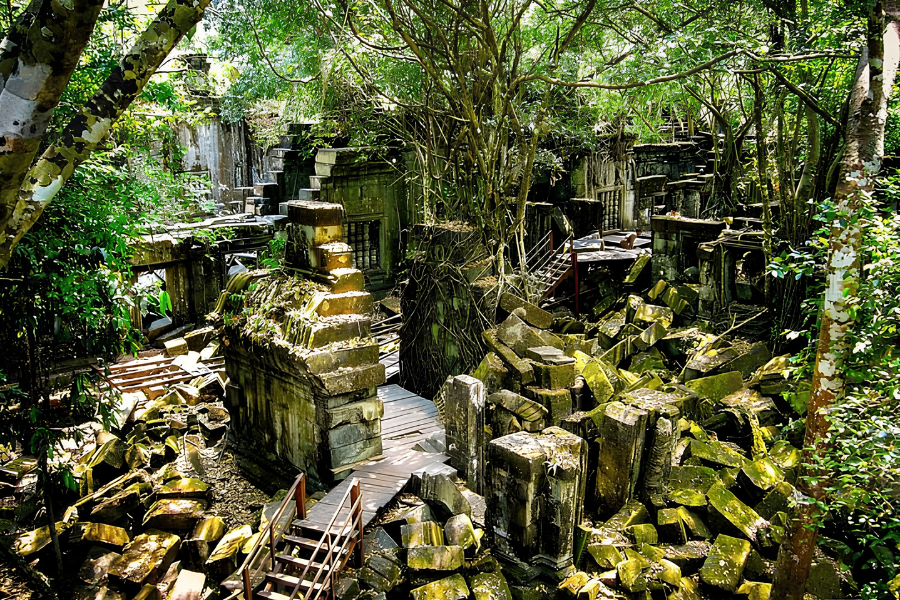
Located 40 kilometers east of Siem Reap, Beng Mealea was built in the early 12th century under King Suryavarman II using the same blueprint and layout as Angkor Wat. Yet, unlike its famous sibling, this sprawling jungle complex remains largely unrestored, resting in a wild, tumbled state amid primary forest.
- Open hours: Daily from 7:30 AM until 5:30 PM (now accessible using the standard Angkor Pass).
- When to visit: Mid-morning (9:00 AM to 11:00 AM) or early afternoon; the site remains uncrowded throughout the day.
- Time needed: 1.5 to 2 hours (plus a 1-hour drive each way).
Massive blocks of blue-grey sandstone lie strewn across collapsed galleries, half-buried beneath climbing ficus roots and wild ferns. A raised wooden boardwalk weaves through the ruins, taking travelers up and over collapsed libraries, across collapsed roofs, and into dark, shadowed corridors where massive eight-headed Naga balustrades remain preserved.
Beng Mealea preserves the authentic sensation of discovery. Moving along the elevated wooden boardwalk beneath the thick forest canopy, the air is cooler and smells of green vines and damp earth. Fallen pillars and carved pediments lie half-swallowed by tree trunks, exactly as European surveyors documented them over a century ago. Without tour group crowds or loudspeaker noise, the forest feels vast and peaceful.
7. Banteay Kdei & Srah Srang: The Cloister of Cells & The Royal Reservoir

Constructed between the late 12th and early 13th centuries by Jayavarman VII, Banteay Kdei (“A Citadel of Monastic Cells”) is a quiet, low-rise Buddhist monastery. Directly across its eastern entrance gate lies Srah Srang, a massive royal water reservoir measuring 700 meters by 350 meters, once used for ceremonial baths and royal regattas.
- Open hours: Daily from 7:30 AM until 5:30 PM (Srah Srang reservoir viewing area opens at 5:30 AM for sunrise).
- When to visit: 4:00 PM to 5:30 PM (explore Banteay Kdei in the shaded late afternoon, then cross the road to watch sunset reflections over Srah Srang).
- Time needed: 1.5 hours combined.
Banteay Kdei was built using a softer, low-grade sandstone that has weathered into warm, golden-brown hues, giving its interior courtyards and smiling face-towers an intimate, worn patina. Directly opposite, Srah Srang’s western landing terrace features stone steps flanked by guardian lions and coiled Naga serpents overlooking a serene, open expanse of water.
Sitting on the lion-carved sandstone landing terrace of Srah Srang as the day winds down is one of the most tranquil rituals in the park. After hours of climbing steep stone stairs, resting here beside the water while cool breezes ripple across the surface is deeply restorative. The water mirrors the changing evening sky from amber to violet, while small wooden boats glide quietly along the far shore.
8. Preah Vihear: The Dramatic Clifftop Sanctuary on Dângrêk Mountain
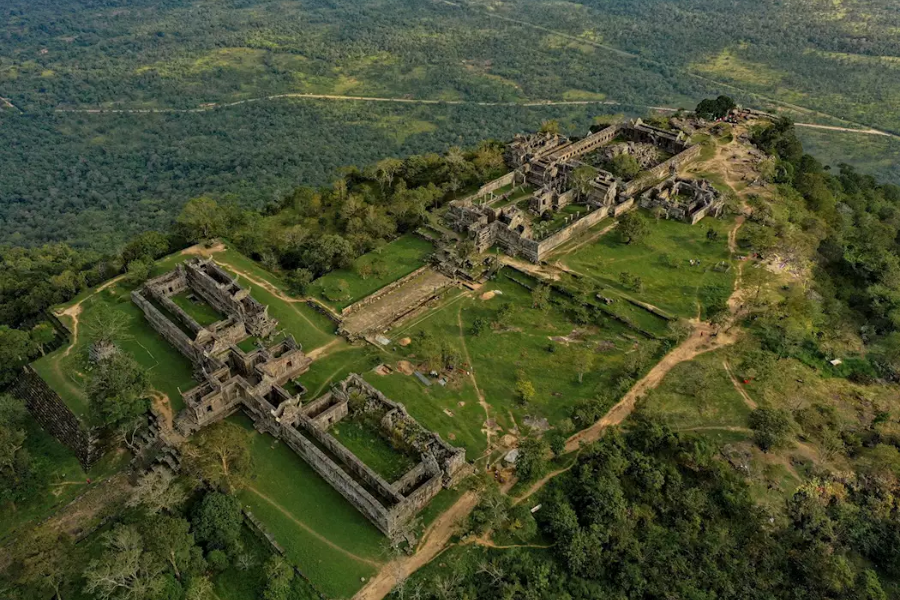
Perched precariously on the edge of a 525-meter cliff along the Dângrêk Mountain range, Preah Vihear is a UNESCO World Heritage site situated along the international border with Thailand. Built over a period of four centuries by several Khmer sovereigns, this temple complex dedicated to Shiva commands the most dramatic geographical setting in Southeast Asia.
- Open hours: Daily from 7:30 AM until 4:30 PM (Requires a separate $10 entrance ticket; original passport is required at the checkpoint).
- When to visit: 8:00 AM to 10:30 AM, before heat and mountain haze obscure the sweeping valley views below.
- Time needed: 2.5 to 3 hours at the summit (plus a 3.5-hour private drive each way from Siem Reap; final ascent requires a dedicated local 4×4 vehicle).
Unlike typical flat or concentric temple plans, Preah Vihear is constructed along an 800-meter north-south axis that rises steadily up the mountain slope. Four successive palatial gopuras connected by stone causeways lead to the fifth and final sanctuary, situated right on the precipice of an abrupt vertical cliff overlooking the Cambodian plains.
The long drive from Siem Reap fades from memory the second you reach the edge of the fifth sanctuary terrace. Standing on the granite precipice, the Cambodian plains stretch out beneath you toward the horizon, framed by white clouds. Mountain breezes sweep through the stone doorframes, and the view down into the green expanse below makes it clear why ancient architects selected this summit as a sacred bridge between heaven and earth.
9. Koh Ker: The Enigmatic 7-Tiered Step Pyramid

Serving as the short-lived imperial capital of the Khmer Empire between 928 and 944 AD under King Jayavarman IV, Koh Ker lies hidden deep within the northern dry forests. Recently inscribed as a UNESCO World Heritage site, its centerpiece, Prasat Thom, displays an architectural design seen nowhere else in Southeast Asia.
- Open hours: Daily from 7:30 AM until 5:30 PM (Separate $15 entrance ticket required).
- When to visit: 10:00 AM to 2:00 PM (typically paired with Beng Mealea on a full-day private excursion).
- Time needed: 2 hours at the complex (plus a 2.5-hour private drive from Siem Reap).
Prasat Thom is a 36-meter-tall, 7-tiered step pyramid constructed of precision-hewn sandstone blocks. Rising vertically above the flat jungle terrain, its silhouette bears an uncanny resemblance to the Mayan step pyramids of Tikal or Chichen Itza. Modern wooden stairs on the rear facade allow safe ascent to the summit platform, which once supported a colossal 4-meter Shiva lingam.
Gazing up at Prasat Thom from the forest clearing, its sheer seven-tiered sandstone face looks entirely distinct from any other classical Angkorian temple. Reaching the top platform via the wooden staircase brings you out above the forest canopy, with endless green hills rolling out in every direction. The total absence of city noise makes Koh Ker feel wild, remote, and preserved in time.
> > > If you are short on time but still want to take in the essential marvels of Siem Reap without the midday heat exhaustion, our compact yet luxurious 5 Days Cambodia Discovery seamlessly blends private sunrise visits to iconic shrines with tranquil wooden boat excursions across Tonle Sap Lake.
8 Essential Insider Tips for Exploring Cambodian Temples
- Strictly Adopt the “Sunrise & Siesta” Routine: The midday tropical sun between 11:30 AM and 2:30 PM is draining. Start early at 5:00 AM to explore during the cool morning air, return to your air-conditioned resort for lunch, a swim, or a spa treatment, and head out again at 3:30 PM for softer light and cooler breezes.
- Account for Angkor Wat’s Unique West-Facing Orientation: Unlike virtually all other temples in Cambodia that face eastward to greet the rising sun, Angkor Wat faces west (associated with Vishnu and eternity). As a result, its main western facade is backlit and shaded in the morning, becoming vibrantly lit with warm golden light from 2:00 PM onward, making afternoon the best time for exterior photography.
- Wear Supportive Footwear with High-Traction Soles: Leave sandals and smooth-soled shoes at the hotel. Temple staircases, especially at monuments like Ta Keo, Pre Rup, and the central towers of Angkor Wat, are exceptionally steep, narrow, and worn smooth by centuries of foot traffic. Lightweight running shoes or specialized walking shoes are essential.
- Prioritize Hydration and Electrolytes: Exploring temple ruins involves walking several kilometers over uneven terrain. Carry a vacuum-insulated water bottle, keep electrolyte rehydration tablets handy, and enjoy fresh, chilled coconuts prepared at reputable stalls outside temple gates.
- Keep Crisp, Unblemished US Currency: US Dollars are used interchangeably with Cambodian Riel throughout Siem Reap. However, local vendors and ticket agents will strictly reject bills that have tiny tears, heavy creasing, or ink marks. Ensure any foreign currency you bring is crisp and in pristine condition.
- Hire a Certified Private Heritage Guide: The complex stone carvings and Sanskrit inscriptions reveal their meaning only when interpreted by a knowledgeable guide. A certified heritage guide helps unlock the mythology, points out hidden architectural details, and navigates you away from large tour groups.
- Show Proper Etiquette Around Monks: If receiving a traditional water blessing or red yarn wristband from resident Buddhist monks, remove your hat and shoes and bow your head respectfully. Female travelers must never touch a monk or hand items directly to them; offerings should be placed on a cloth or tray. A small donation ($1 to $5) to the temple box is customary.
- Politely Decline Unofficial “Guides” and Temple Scams: Inside popular ruins like Bayon or Angkor Wat, individuals dressed in security attire or casual clothing may gesture toward “secret photo spots” or hand you incense sticks to place before a Buddha statue, later demanding an aggressive tip. A firm, polite smile and a shake of the head are all that is required to move past them.
Experiencing the Kingdom of Wonder goes far beyond temple courtyards; it is equally about understanding local customs, authentic Khmer dining, and respectful monastery interactions. For a complete orientation covering currency rules, etiquette, and regional sights, explore our in-depth Cambodia Travel Guide before you pack your bags.
Elevate Your Journey: Combine Cambodia’s Temples with Vietnam
The contrast between Cambodia’s ancient stone cities and Vietnam’s living culture makes pairing the two nations the gold standard for Southeast Asian travel.
- Convenient Direct Aviation Hubs: Regular non-stop flights link Siem Reap directly with Hanoi (1 hour 45 minutes), Da Nang (2 hours), and Ho Chi Minh City (1 hour 15 minutes), making border crossings smooth and fast.
- The Boutique Mekong River Connection: For an unhurried, romantic journey, travel between the two countries aboard an intimate luxury river cruiser (such as Heritage Line or Aqua Mekong), sailing smoothly past floating markets and rural riverside villages between Saigon, Phnom Penh, and Siem Reap.
- Tailored Private Touring: Rather than worrying about logistical connections, selecting a bespoke private travel designer ensures that your flights, private ground transfers, fast-track visas, and private guides align seamlessly across borders.
From the first glimmer of daylight warming the stone lotus spires of Angkor Wat to the quiet shade beneath the ancient roots of Ta Prohm, the temples of Cambodia stand among humanity’s greatest achievements. They are not merely ancient ruins, they are living monuments that invite you to step back, listen, and marvel.
Ready to discover the legendary wonders of Angkor, the limestone karsts of Halong Bay, and the vibrant culture of Vietnam? Contact us today to create a custom, seamlessly coordinated journey tailored precisely to your schedule, pace, and passions.
Tags: best temples in cambodia, cambodia, cambodia temples, cambodian temples, famous cambodian temples, siem reap temples, temple of cambodia, temples in Cambodia, vietnam and cambodia trip