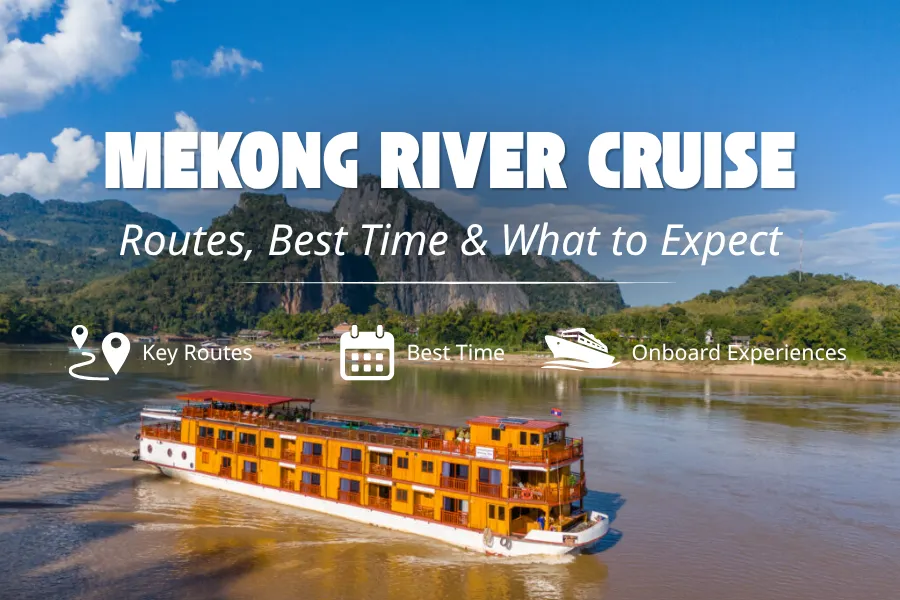
A Mekong River cruise is not simply a slower way to travel between Vietnam and Cambodia. Much of the appeal comes from what happens between the major cities: smaller river towns, villages, markets, temples and stretches of countryside that are easy to miss when moving quickly by road or air.
The harder part is choosing the right route. Some cruises spend three or four nights between southern Vietnam and Phnom Penh, while longer journeys continue through Cambodia towards the Siem Reap area. Water levels can also affect how the Cambodian section operates, particularly around Tonle Sap.
Ship style matters too. A small boutique vessel and a larger luxury river ship may follow similar waterways but feel quite different once you are on board. This guide explains the main routes, the best time to cruise, what to expect each day and what to check before booking.
Mekong River Cruise at a Glance
For most first-time travelers, the Lower Mekong between Vietnam and Cambodia is the most practical place to start.
|
Route |
Typical cruise length |
Best for |
|
Southern Vietnam to Phnom Penh |
3 nights |
Shorter first cruise |
|
Vietnam to Siem Reap area |
Around 7 nights |
Full Vietnam–Cambodia journey |
|
Phnom Penh to Siem Reap area |
Around 4 nights |
Cambodia-focused trips |
|
Short Mekong Delta cruise |
1–2 nights |
Vietnam itineraries with limited time |
Current Lower Mekong programs commonly include seven-night Saigon–Siem Reap journeys, three-night Saigon–Phnom Penh sectors and four-night Phnom Penh–Siem Reap sectors, although exact routing changes by ship and season.
If time allows, the full Vietnam–Cambodia route gives the best sense of how life changes along the river. If you only have three or four nights, a shorter Vietnam–Phnom Penh sector is easier to fit into a wider itinerary.
Main Mekong River Cruise Routes
Southern Vietnam to Phnom Penh
- Typical duration: Around 3 nights
- Best for: First-time cruisers, shorter holidays and travelers continuing through Cambodia by land or air
- Highlights: Mekong Delta waterways, local villages, river markets, cross-border journey and arrival in Phnom Penh
This is one of the easiest ways to add a Vietnam Cambodia river cruise without committing a full week to the river. Depending on the cruise line, embarkation may take place in Ho Chi Minh City, Can Tho or another Mekong Delta port, sometimes with a transfer included from the city.
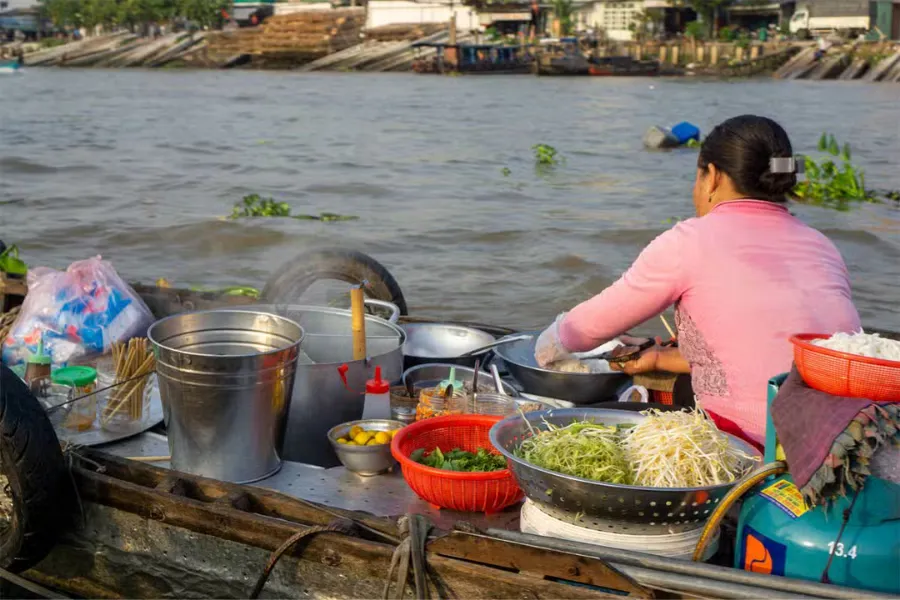
Once on the river, the landscape quickly changes from urban edges to smaller waterways, farmland and riverside communities. Shore excursions vary by ship, but they often include village walks, small workshops, temples, markets or local cultural visits. The point is not to rush through as many attractions as possible. A short Mekong cruise works best when you allow the slower pace to be part of the experience.
The journey then continues towards the Vietnam–Cambodia border before reaching Phnom Penh. Heritage Line, for example, currently operates a three-night Saigon–Phnom Penh sector as part of its Lower Mekong programme. Other operators may begin farther into the Delta or package the same route differently.
This route makes sense if your wider Vietnam and Cambodia trip already includes Phnom Penh and Angkor but you do not want to spend seven nights on the river. It is also a good introduction for travelers unsure whether they will enjoy a longer cruise.
Vietnam to Cambodia: The Full Mekong Journey
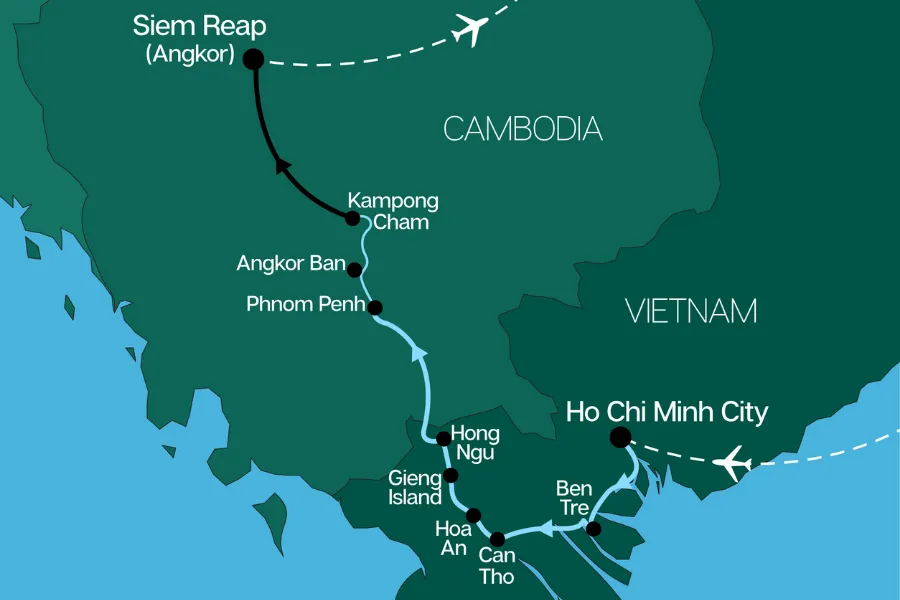
- Typical duration: Around 7 nights
- Best for: First-time Vietnam–Cambodia travelers, couples, mature travelers and anyone who prefers slower travel
- Highlights: Mekong Delta, Phnom Penh, rural Cambodia, river villages, temples and access towards Siem Reap depending on water level
This is the classic Lower Mekong journey. The route typically begins in southern Vietnam, passes through the Delta, crosses into Cambodia, stops in Phnom Penh and continues north through smaller towns and villages towards the Siem Reap side of the country.
The main advantage is continuity. Instead of checking in and out of hotels every one or two nights, you unpack once and allow the ship to move between places for you. There is usually a rhythm to the day: breakfast, a morning excursion, lunch on board, sailing time, another visit in the afternoon and dinner in the evening. The route also gives Phnom Penh a natural place in the itinerary rather than treating it as a quick flight connection between Vietnam and Siem Reap.
For travelers considering Vietnam & Cambodia Private Tours, a full Mekong cruise can replace part of the usual overland journey and turn the transfer between the two countries into part of the trip itself.
The main thing to understand before booking is that the final Cambodian section depends on water levels. During higher water, some ships can cross Tonle Sap and operate much closer to Siem Reap. During lower water, they may finish at Kampong Cham or another river point, with a road transfer completing the journey. Heritage Line currently describes high water as roughly mid-August to mid-November, with low-water arrangements operating for the rest of the year. That does not make the low-water route a poor option. It simply changes the logistics.
> > > For travelers with a little more time, Vietnam and Cambodia Discovery in 16 Days allows a slower journey through both countries, with additional time for the Mekong Delta before continuing towards Phnom Penh and Siem Reap.
Phnom Penh to Siem Reap
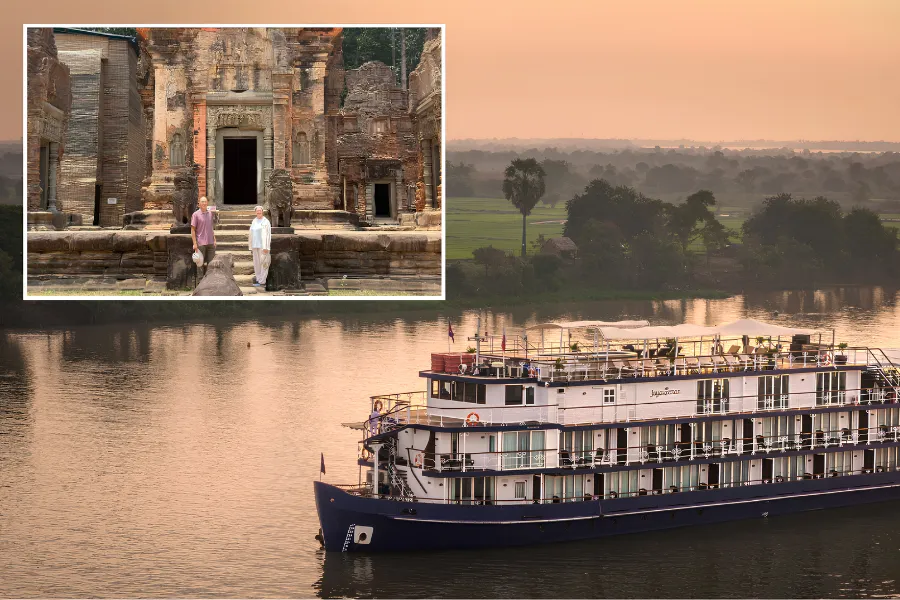
- Typical duration: Around 4 nights
- Best for: travelers already in Cambodia, shorter Cambodia itineraries and trips centred around Angkor
- Highlights: Phnom Penh, temples, villages, rural river life and Tonle Sap when conditions allow
This route concentrates on the Cambodian side of the Mekong system. It usually suits travelers who have already explored Vietnam separately or who simply want to combine Phnom Penh and Angkor with several nights on the river.
The journey feels different from the Vietnamese section. You are likely to spend more time around smaller Cambodian communities, temples and broad river landscapes, with the exact route changing according to water conditions.
During high-water periods, ships may be able to use Tonle Sap and reach a pier closer to Siem Reap. During low water, the vessel may stop at Kampong Cham, followed by a longer road transfer. That distinction is important when comparing itineraries because two cruises with similar names may involve quite different embarkation or disembarkation logistics depending on the month.
Short Mekong Delta Cruise in Vietnam
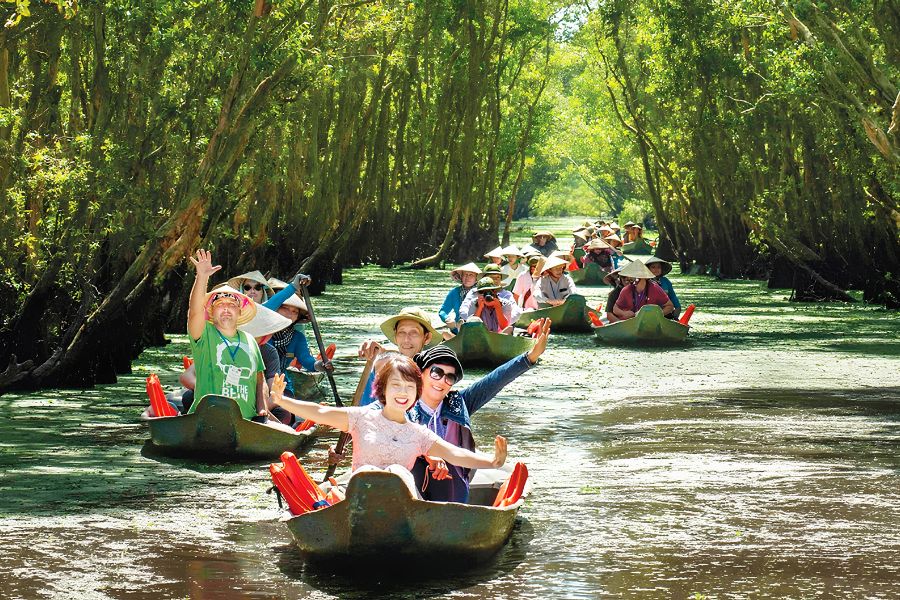
- Typical duration: 1–2 nights
- Best for: travelers staying mainly in Vietnam, first-time river cruisers and shorter holidays
- Highlights: Delta waterways, villages, orchards, small workshops and evenings on the river
You do not need to cross into Cambodia to experience the Mekong by boat. A short Delta cruise can work well as an extension from Ho Chi Minh City, particularly if you have limited time and still want more than a standard day trip.
The experience is smaller in scale than a full cross-border journey. You may spend time around narrower waterways, visit riverside communities, stop at local workshops or simply have the opportunity to see the Delta after most day visitors have returned to the city. This option suits travelers who want a taste of the river without building their whole itinerary around a cruise. It is also useful if Cambodia is not part of the trip.
Upstream or Downstream: Does Direction Matter?
Cruise operators usually describe the journey from Vietnam towards Cambodia as upstream, while the reverse route is downstream.
Neither direction is automatically better. If your wider itinerary starts in Hanoi and continues south through Vietnam, traveling Vietnam to Cambodia often creates the most natural flow. You can move from northern and central Vietnam to Ho Chi Minh City, continue through the Mekong Delta by river and finish around Phnom Penh or Siem Reap. The reverse works just as well if your trip begins around Angkor.
|
Vietnam to Cambodia |
Cambodia to Vietnam |
|
Works naturally after a Vietnam itinerary |
Works naturally after Angkor |
|
Phnom Penh comes before Siem Reap on longer routes |
Phnom Penh leads towards southern Vietnam |
|
Good if Cambodia is the final part of the trip |
Good if you want to finish in Ho Chi Minh City |
|
Easy to combine with Hanoi, Halong Bay and Central Vietnam first |
Easy to add southern Vietnam or beach time afterwards |
As first-time cruise guides also point out, direction should usually be chosen according to what comes before and after the cruise rather than the scenery itself. The better direction is the one that makes the wider trip easier.
Best Time for a Mekong River Cruise
The phrase “best time” is slightly misleading on the Mekong because the best weather and the highest water levels do not happen at exactly the same time.
November to February: Best Overall Weather
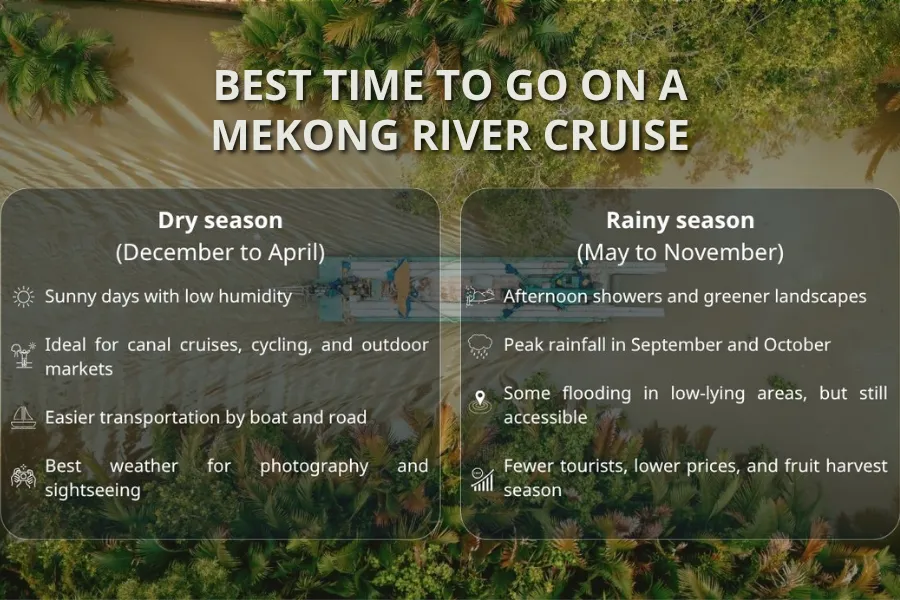
For many travelers, November through February offers the most comfortable conditions. Humidity is generally easier to manage, temperatures are less intense than late spring and rain is less frequent than in the wet season. Many cruise specialists therefore recommend the dry season, broadly November to April, with November to February particularly comfortable for excursions.
This period is especially good if you are combining the cruise with walking tours in Phnom Penh, temple visits and time in Ho Chi Minh City. The trade-off is lower water. That matters most on the Cambodian side.
Mid-August to Mid-November: Higher Water
Higher water can open up a different route through Cambodia. Its high-water period is approximately mid-August to mid-November, although the exact dates vary each year with rainfall. During this period, vessels may be able to cross Tonle Sap and operate directly to a Siem Reap-area pier. This can reduce road-transfer time and make the Cambodian section feel more continuous.
You should not, however, interpret “high water” as “best weather”. August, September and October are still within the wetter part of the year. You may have more rain even though the river route is more favourable.
Low Water: What Changes?
Low-water cruises still operate. The difference is mainly logistical. During low water, roughly mid-November to late August, its ships cannot complete the Tonle Sap crossing and instead use Kampong Cham with a shuttle transfer to or from Siem Reap. Its Vietnam sector between Phnom Penh and Saigon is not affected by the same water-level issue.
This is one of the most important things to understand before booking. Best weather and highest water levels are not the same thing. If your priority is comfortable sightseeing weather, choose the drier months. If reaching Siem Reap by river is especially important, look closely at high-water departures and the cruise line’s current operating notes.
If the cruise is part of a longer two-country journey, our guide to the Best Time to Visit Cambodia and Vietnam looks beyond river conditions to compare weather across both countries and help you choose the right travel period.
What to Expect on a Mekong River Cruise
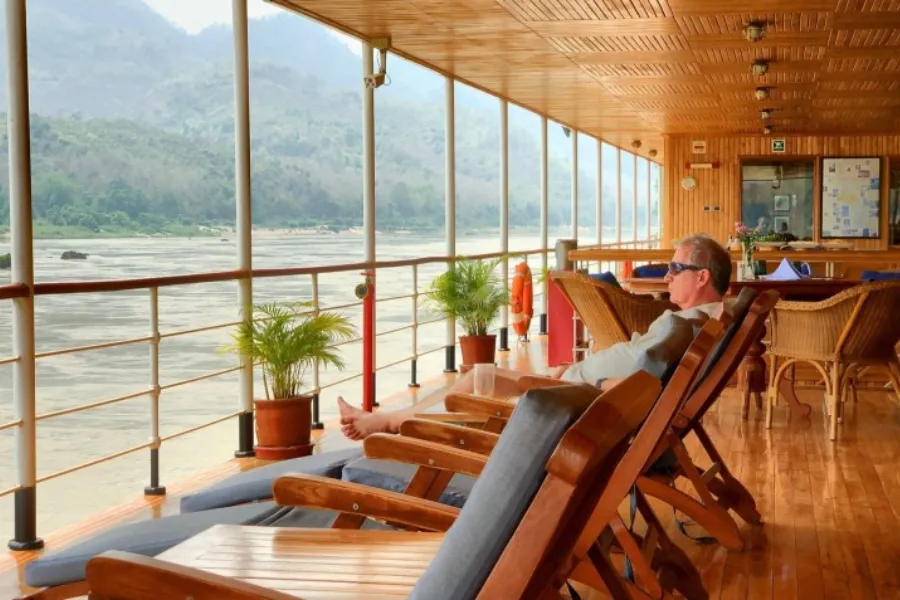
A river cruise here is quite different from an ocean cruise. There are no long sea days, large entertainment programmes or formal evenings built around theatres and casinos. The river itself and the places along it are the focus.
|
Experience |
What to expect |
|
Life on board |
Breakfast, excursions, lunch, sailing time and evening meals |
|
Scenery |
Riverbanks, farms, villages, temples and working river life |
|
Shore excursions |
Markets, workshops, temples, walking and sometimes cycling |
|
Pace |
Slower than a standard land itinerary |
|
Evenings |
Usually quiet, with dinner, drinks and time on deck |
A typical morning may begin with breakfast before boarding a smaller excursion boat or going ashore. Some days include village walks. Others focus on temples, markets, local crafts or cultural visits. You then return to the ship for lunch while it continues along the river.
The afternoon may include another excursion, or simply several hours of sailing. This slower section is part of the appeal. A scenic Mekong River cruise is less about one spectacular view and more about watching everyday life change along the river. Fishing boats pass by. Houses appear close to the water. Children cycle along embankments. Temples rise behind villages. Agricultural land gradually gives way to larger towns.
The scenery can be very peaceful, but it is important to have the right expectation. The Mekong is not a river of constant mountain panoramas. Much of the experience is cultural rather than purely scenic. That is why travelers interested in local life often enjoy it more than those expecting dramatic landscapes for eight hours a day.
Evenings are generally relaxed. Depending on the ship, you may have cocktails on the sun deck, a short cultural performance, a cooking demonstration or simply dinner followed by time in the lounge. You do not usually need formal cruise wear.
Once the cruise reaches Cambodia, food becomes another part of the experience. Our guide to the Best Food in Cambodia To Try introduces the dishes and local flavors worth looking out for in Phnom Penh, Siem Reap and beyond.
What Does a Luxury Mekong Cruise Actually Include?
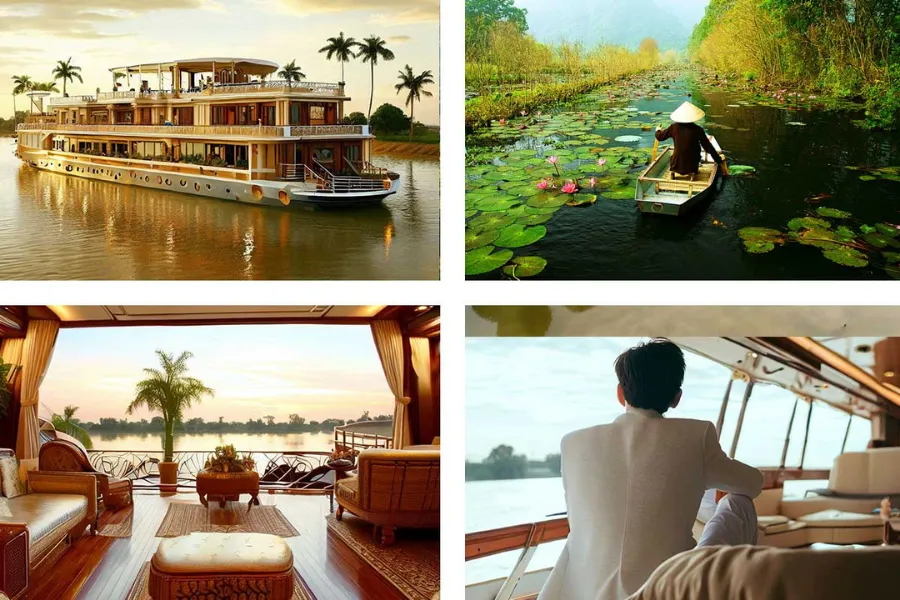
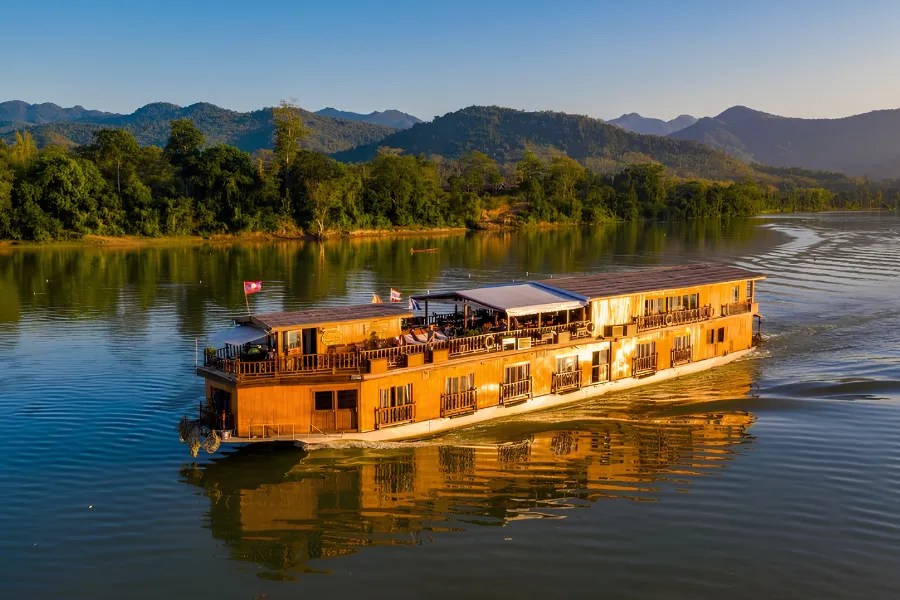
The phrase luxury Mekong cruise can mean different things depending on the operator. Some ships emphasise large suites and private balconies. Others are smaller and more intimate, with fewer cabins, stronger guide-to-guest ratios or more personalised excursions. Common features on luxury Mekong River cruises can include:
- Larger cabins or suites
- Private balconies or floor-to-ceiling windows
- Full-board dining
- Sundeck and lounge
- Swimming pool or plunge pool on some ships
- Spa or massage treatments
- Guided shore excursions
- Group transfers at selected embarkation points
- Cultural activities on board
- Selected drinks, depending on the operator
Current luxury ships on the river vary significantly. Victoria Mekong, for example, operates with 35 cabins and includes facilities such as a pool and spa, while Heritage Line vessels use a boutique small-ship format with fewer cabins and extensive excursion programmes. This is why cabin photos should not be the only thing you compare.
Two Mekong river luxury cruises may look equally polished online but differ greatly in:
- cabin size;
- excursion group size;
- drinks included;
- balcony design;
- transfer arrangements;
- dining style;
- number of guests;
- overall pace.
Route and excursion style can matter just as much as the suite itself.
How Many Days Do You Need?
The right cruise length depends on how much of the river you want to experience and how much time you have for the rest of Southeast Asia.
|
Time available |
Best fit |
|
1–2 nights |
Short Mekong Delta experience |
|
3–4 nights |
Vietnam–Phnom Penh or Cambodia sector |
|
7–8 nights |
Full Vietnam–Cambodia river journey |
|
10+ days overall |
Cruise plus Hanoi, Halong Bay, Ho Chi Minh City or Angkor |
A one- or two-night cruise gives you a sense of the Delta but not the full cross-border experience. Three or four nights works well if the river is one part of a larger itinerary. Seven nights is where the experience starts to feel complete. You have time to settle into the ship, see both countries and avoid feeling that every day is dominated by embarking and disembarking.
If you are already planning a longer Vietnam & Cambodia Private Tours itinerary, seven nights on the river can work especially well when combined with private touring in Hanoi, Halong Bay, Central Vietnam and Angkor before or after the cruise.
The key is balance. A week on the river followed by another two weeks of very slow touring may feel too relaxed for some travelers, while a short cruise inserted into an otherwise rushed itinerary can feel like a welcome change of pace.
> > > If you want to combine the Mekong with a wider journey through both countries, the Vietnam and Cambodia Trip in 14 Days brings together Vietnam’s main cultural highlights, the Mekong Delta and Angkor in a two-week itinerary.
Practical Tips Before Booking a Mekong River Cruise
- Choose the route before choosing the ship. A beautiful cabin does not help if the route does not fit the rest of your trip. Decide first whether you want Vietnam to Phnom Penh, the full Vietnam–Cambodia journey or a shorter Cambodia sector.
- Check the actual number of cruise nights. An itinerary advertised as eight or ten days may include hotel nights, land touring or transfers. Check how many nights you are physically sleeping on the ship.
- Ask which water-level itinerary applies. This matters most around the Siem Reap end of the journey. High- and low-water programmes can involve different embarkation points and longer road transfers. Heritage Line specifically advises guests to check this before departure.
- Check the exact embarkation point. “Saigon departure” does not always mean the vessel is moored in central Ho Chi Minh City. Some cruises include a group transfer from a city meeting point to the ship.
- Look carefully at cabin size and location. A seven-night cruise makes room layout more important than it would be on a one-night stay. Check deck position, window style, balcony type and whether the cabin is close to the engine or public areas.
- Compare what is actually included. Meals are commonly included, but drinks, premium beverages, spa treatments, gratuities and some optional excursions may not be. Transfer policies also vary between operators.
- Check excursion style and group size. Some ships run larger organized groups, while others place more emphasis on smaller-group or private experiences. If you dislike moving around in a large group, this can matter more than having a bigger cabin.
- Think about mobility. River cruising is relatively relaxed, but shore excursions may involve uneven village paths, small boats, gangways and temple steps. Ask about accessibility if anyone in your party has limited mobility.
- Pack for the shore, not just the ship. Bring lightweight clothing, comfortable walking shoes, sun protection, a hat, insect repellent and a light rain layer. Modest clothing is useful for temple visits.
- Do not over-pack formal clothes. Most Mekong cruises have a relaxed atmosphere. Smart-casual evening wear is usually enough unless your operator specifically advises otherwise.
- Keep passport and visa documents accessible. Cross-border cruises involve immigration formalities. Visa requirements depend on nationality and can change, so check the rules for both Vietnam and Cambodia well before departure.
- Avoid tight flight connections after disembarkation. River conditions, road transfers and local logistics can affect arrival times. Leave a sensible buffer before any same-day international flight.
FAQs About Mekong River Cruises
- What is the best Mekong River cruise for first-time travelers?
For most first-time travelers with enough time, a seven-night Vietnam–Cambodia route offers the best overall introduction because it includes the Mekong Delta, Phnom Penh and the Cambodian river section. If you only have three or four nights, a shorter Vietnam–Phnom Penh route is easier to fit into a larger itinerary. - How many days do you need for a Mekong River cruise?
Three to four nights is enough for a short introduction, while around seven nights works better for the full Vietnam–Cambodia experience. One- or two-night Delta cruises are useful when your trip focuses mainly on Vietnam. - Can you cruise from Vietnam to Cambodia?
Yes. Several operators run cross-border Mekong cruises between southern Vietnam and Cambodia. Common routes include Saigon or the Mekong Delta to Phnom Penh and longer journeys continuing towards the Siem Reap area. - Can a Mekong cruise go all the way to Siem Reap?
Sometimes, depending on the ship, season and water level. During high-water periods, some vessels can cross Tonle Sap and use a pier closer to Siem Reap. During low water, cruises may end at Kampong Cham or another river point, with the final journey completed by road. - What is the best month for a Mekong River cruise?
November to February is generally the easiest period for comfortable weather. However, higher water levels usually occur around mid-August to mid-November, which may allow a more direct river connection towards Siem Reap. The best month therefore depends on whether weather or river access matters more to you. - What is included on a luxury Mekong cruise?
Most luxury cruises include accommodation, meals and guided shore excursions. Many also include selected transfers and onboard activities. Drinks, premium beverages, spa treatments, gratuities and optional excursions vary by cruise line. Always compare inclusions carefully before booking. - Are Mekong River cruises suitable for families?
They can be, particularly for families with older children who are interested in culture and comfortable with guided excursions. For very young children, the slower pace and longer shore excursions may be less suitable. Families should also check minimum-age policies with the individual cruise operator. - What is the difference between high-water and low-water itineraries?
The main difference is on the Cambodian side. High water may allow vessels to cross Tonle Sap and operate closer to Siem Reap. In lower water, ships may use Kampong Cham with a road transfer to or from Siem Reap. The Vietnam section between Phnom Penh and southern Vietnam is generally less affected.
Is a Mekong River Cruise Worth Adding to Your Trip?
A Mekong cruise makes the most sense when you want the journey between Vietnam and Cambodia to become part of the holiday rather than simply moving from one country to the next. A short cruise gives you a taste of the Delta and works well when time is limited. A seven-night journey allows more time to settle into the rhythm of the river, visit Phnom Penh and see how communities and landscapes change as you move between Vietnam and Cambodia.
The most important decision is not necessarily which ship looks the most luxurious. Start with the route, the season and the number of nights. Then compare the vessel, cabin and excursion style. That usually leads to a better choice than selecting a ship first and trying to make the rest of the itinerary fit around it.
If you are planning Vietnam & Cambodia Private Tours, LuxeTravel Asia can combine a Mekong River cruise with private touring before and after the river journey, including Hanoi, Halong Bay, Ho Chi Minh City, Phnom Penh and Angkor.
Plan Your Journey with LuxeTravel Asia and we can help match the cruise route, season and wider itinerary to the way you prefer to travel.
Tags: best Mekong River Cruise, cruise from vietnam to cambodia, luxury mekong cruise, luxury mekong river cruises, mekong cruises, mekong river cruise, mekong river luxury cruises, scenic mekong river cruise, vietnam cambodia river cruise