
Deciding how many days to spend in Vietnam and Cambodia is harder than it first appears. Cambodia’s best-known sights are relatively concentrated around Siem Reap and Phnom Penh, while Vietnam stretches more than 1,600 kilometers from north to south, with very different experiences in each region.
10 days can work if you are selective. Two weeks gives first-time visitors a much better balance, while 16 to 18 days creates room for the Mekong Delta, Phnom Penh and a less rushed pace. With three weeks, the biggest benefit is not simply seeing more places. It is having more time in them. The right Vietnam and Cambodia itinerary therefore depends on more than the number of days available. Travel pace, hotel changes, domestic flights and how much free time you want all matter.
This guide compares realistic 10, 14, 16 to 18 and 21-day routes so you can decide what actually fits your trip.
How Many Days Do You Need for Vietnam and Cambodia?
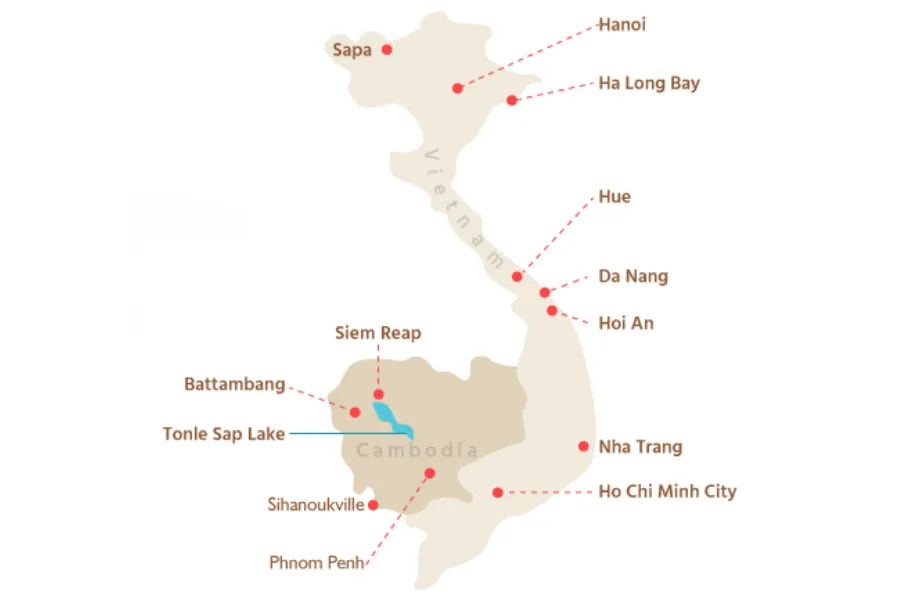
For most first-time visitors, 14 to 16 days is a good starting point for combining both countries without making every second day a transfer day. Current itinerary guides similarly place around two weeks as the most balanced option, while three weeks allows additional stops and a slower pace.
|
Time available |
What it feels like |
Best for |
|
7 to 10 days |
Fast, highlights only |
Limited annual leave |
|
14 days |
Well-balanced introduction |
First-time visitors |
|
16 to 18 days |
More complete and comfortable |
Couples, families, private travel |
|
21 days |
Slower and more immersive |
Seniors, longer holidays, deeper travel |
Vietnam usually needs the larger share of the itinerary because its main destinations are spread across the north, center and south. Cambodia can be explored more selectively. Siem Reap normally needs several days if you want more than a quick visit to Angkor Wat, while Phnom Penh adds another one or two nights. The biggest mistake is trying to give both countries equal time simply because there are two of them.
Vietnam and Cambodia in 10 Days: Highlights Only

- Best for: travelers with limited time
- Recommended pace: Fast
- Suggested split: Around 6 days in Vietnam and 4 days in Cambodia
Ten days is possible, but it requires discipline. This is not the trip for adding Hue because it looks interesting, squeezing in Ninh Binh because someone recommended it, and then deciding Phnom Penh should fit too. A realistic itinerary needs to focus on a few major experiences.
Suggested 10-Day Itinerary
- Days 1 to 2: Hanoi
- Days 3 to 4: Halong Bay
- Days 5 to 6: Ho Chi Minh City
- Day 7: Fly to Siem Reap
- Days 8 to 9: Angkor
- Day 10: Departure
This roughly follows the logic used in other current 10-day combined itineraries: a small number of major destinations, direct flights between regions and several days reserved for Siem Reap rather than attempting to cover everything.
Pros
- Covers several major highlights in a short holiday
- Works when annual leave is limited
- Keeps the itinerary focused
- Lower overall trip cost than a longer journey
- Avoids spending too much time in any one region
Cons
- Several travel days within a short trip
- Little room for Hoi An, Hue, Ninh Binh or Phnom Penh
- Very limited flexibility if a flight or transfer changes
- Little free time
- Not ideal for travelers who dislike frequent packing
Ten days works when you are happy choosing a few highlights rather than trying to see Vietnam and Cambodia in full. If Cambodia is the bigger priority, another good 10-day approach is to focus on southern Vietnam, the Mekong Delta, Phnom Penh and Siem Reap instead of trying to include Hanoi and Halong Bay.
Vietnam and Cambodia in 14 Days: Best for First-Time Visitors

- Best for: A first trip to both countries
- Recommended pace: Moderate
- Suggested split: Around 9 to 10 days in Vietnam and 4 to 5 days in Cambodia
14 days is where a combined trip starts to feel much more complete. You can experience northern, central and southern Vietnam before continuing to Angkor without spending the entire holiday in airports.
Suggested 14-Day Itinerary
- Days 1 to 2: Hanoi
- Days 3 to 4: Halong Bay
- Days 5 to 6: Hoi An
- Days 7 to 8: Ho Chi Minh City
- Days 9 to 10: Mekong Delta
- Days 11 to 14: Siem Reap and Angkor
The main compromise is Phnom Penh. You can technically fit it in, but doing so may mean cutting time elsewhere or creating another short hotel stay. Current two-week itinerary guidance likewise tends to prioritise Hanoi, Halong Bay, Hoi An, Ho Chi Minh City and Siem Reap, with Phnom Penh becoming easier once the trip reaches 16 days.
Pros
- Good balance between Vietnam and Cambodia
- Covers three distinct regions of Vietnam
- Enough time for Angkor without rushing
- Suitable for most first-time visitors
- Gives more variety than a short highlights trip
- Works particularly well as a private itinerary
Cons
- Domestic flights are still necessary
- Phnom Penh may need to be left out
- Limited room for Ninh Binh, Hue or beach time
- Several two-night stays
- Adding “just one more destination” can quickly make the itinerary too busy
With 14 days, the question is not what else you can add. It is what you should leave out. That mindset usually produces a better trip.
> > > If two weeks fits your schedule, the Vietnam and Cambodia Trip in 14 Days follows a focused route through both countries, combining Vietnam’s main highlights with the Mekong region and Angkor.
Vietnam and Cambodia in 16 to 18 Days: The Better Balance

- Best for: Couples, families and private travelers
- Recommended pace: Comfortable
- Suggested split: Around 11 to 12 days in Vietnam and 5 to 6 days in Cambodia
For many travelers, this is the sweet spot. 16-18 days gives you enough time to include Phnom Penh, spend longer in the Mekong region or add Hue without making every extension feel like a compromise. A current 16-day Vietnam–Cambodia itinerary, for example, includes Hanoi, Halong Bay, Hoi An, Ho Chi Minh City, the Mekong region, Phnom Penh and several nights in Siem Reap.
Suggested 16 to 18-Day Itinerary
- Days 1 to 2: Hanoi
- Days 3 to 4: Halong Bay
- Days 5 to 7: Hue and Hoi An
- Days 8 to 9: Ho Chi Minh City
- Days 10 to 11: Mekong Delta
- Days 12 to 13: Phnom Penh
- Days 14 to 17: Siem Reap and Angkor
- Day 18: Departure or additional free time
The exact balance can change. If Hue is less important to you, give Hoi An an extra day. If you prefer rivers and slower travel, spend more time in the Mekong Delta and travel towards Phnom Penh by river.
This is also where Vietnam and Cambodia private tours start to make particularly good sense. There is enough time to adjust the number of nights, hotel style and sightseeing pace around your interests instead of simply following the shortest connection between major attractions.
Pros
- Phnom Penh fits much more naturally
- More room for the Mekong Delta
- Better balance between touring and free time
- Less pressure to leave each destination after one full day
- Strong length for couples and families
- Easier to adjust for different travel styles
- Domestic transfers feel less dominant
Cons
- Higher overall cost
- Requires more annual leave
- Sapa or beach time still needs careful planning
- It is easy to fill the extra days with too many destinations
- Longer itineraries need good routing to avoid unnecessary backtracking
An 18-day trip should feel more comfortable than a 14-day trip. If it simply contains four more attractions, something has gone wrong with the planning.
Angkor Wat may be the best-known temple, but it is only part of Cambodia’s wider temple landscape. Our guide to the Best Temples in Cambodia covers the major sites around Siem Reap and other temples worth considering if you have more time.
Vietnam and Cambodia in 21 Days: Travel More Slowly

- Best for: Longer holidays, seniors and travelers who prefer a relaxed pace
- Recommended pace: Relaxed
- Suggested split: Around 13 to 14 days in Vietnam and 7 to 8 days in Cambodia
Three weeks opens up much more flexibility. Current 21-day routes often add destinations such as Ninh Binh, Hue and Phnom Penh while keeping the major north-to-south flow intact.
Suggested 21-Day Itinerary
- Days 1 to 3: Hanoi
- Days 4 to 5: Ninh Binh
- Days 6 to 7: Halong Bay
- Days 8 to 9: Hue
- Days 10 to 12: Hoi An
- Days 13 to 14: Ho Chi Minh City
- Days 15 to 16: Mekong Delta
- Days 17 to 18: Phnom Penh
- Days 19 to 21: Siem Reap and Angkor
You could easily add more but that does not mean you should. The real benefit of three weeks is being able to spend three nights somewhere instead of two, have a free afternoon after a flight and avoid sightseeing from early morning until evening every day.
Pros
- More time in each destination
- Ninh Binh, Hue and Phnom Penh can be included comfortably
- Fewer rushed mornings
- Better for longer cultural visits
- More suitable for travelers who value downtime
- Good option for senior travelers
- Easier to include free evenings and flexible days
Cons
- Higher overall budget
- Longer time away from home
- Easy to over-plan because more days are available
- Requires care to keep the itinerary varied
- travelers who enjoy a very fast pace may prefer a shorter trip
Three weeks should not mean three more hotel changes. It should mean longer stays and fewer rushed mornings.
How Should You Divide Your Time Between Vietnam and Cambodia?
Vietnam normally deserves more time. The country’s major destinations are spread over a much greater distance, and Hanoi, Central Vietnam and Ho Chi Minh City all feel quite different from one another. Cambodia’s most important first-time attractions are more concentrated, particularly around Siem Reap. A useful starting point is:
|
Total trip |
Vietnam |
Cambodia |
|
10 days |
6 days |
4 days |
|
14 days |
9 to 10 days |
4 to 5 days |
|
16 days |
10 to 11 days |
5 to 6 days |
|
18 days |
11 to 12 days |
6 to 7 days |
|
21 days |
13 to 14 days |
7 to 8 days |
These are guidelines rather than rules. If Angkor archaeology is the main reason for your trip, give Siem Reap more time. If food, landscapes and regional culture are your priorities, Vietnam may deserve an even larger share. If you want to include both Phnom Penh and Siem Reap, Cambodia generally needs at least five to six days to avoid becoming a sequence of transfers.
Which Route Works Best?
There are many ways to combine the two countries, but three routes cover most first-time trips.
Vietnam First: Hanoi to Siem Reap
Best for: First-time visitors and north-to-south Vietnam journeys
The flow is straightforward:
Hanoi → Halong Bay → Central Vietnam → Ho Chi Minh City → Mekong Delta → Cambodia
This works well because the distances naturally move south rather than requiring backtracking. Finishing around Angkor also gives the trip a strong final chapter. If this is your first visit to both countries, this would normally be our preferred direction.
Cambodia First: Siem Reap to Hanoi
Best for: travelers with better flights into Cambodia or those who want Vietnam at the end
This direction works just as well. Begin around Angkor, continue through Phnom Penh and southern Vietnam, then move north through the country. The advantage is finishing around Hanoi and Halong Bay, which can be useful if your onward international flight leaves from northern Vietnam. Neither direction is inherently better. Flight schedules and what comes before or after the trip often make the decision.
Vietnam to Cambodia Through the Mekong
Best for: Longer itineraries and travelers who prefer slower travel
Instead of flying directly from Ho Chi Minh City to Cambodia, travel through the Mekong region. This might mean an overnight stay in the Delta followed by a speedboat connection towards Phnom Penh, or several nights aboard a Mekong river cruise. The journey becomes an experience rather than simply a transfer. This option works particularly well once you have at least 16 days because the river journey takes more time than flying.
> > > For travelers who prefer a little more time between the main stops, Vietnam and Cambodia Discovery in 16 Days adds a more comfortable pace through Vietnam before continuing to Phnom Penh and Siem Reap.
Vietnam and Cambodia Tours for Seniors: How Many Days Work Best?

There is no single itinerary that suits every older traveler. Fitness, travel experience and personal pace matter far more than age alone. But in practice, Vietnam and Cambodia tours for seniors often work better when there is more space between the major sightseeing days.
14 Days
Possible if the itinerary is selective. Focus on the major highlights and avoid adding extra destinations simply because they are nearby.
16 to 18 Days
For many senior travelers, this is the best balance. You can include the major highlights while keeping more two- or three-night stays and reducing the number of very early departures.
21 Days
Best when a slower pace is important. Three weeks allows more relaxed mornings, free afternoons and fewer back-to-back transfers. Some practical choices make a noticeable difference:
- Keep one-night hotel stays to a minimum
- Use private transfers where they improve comfort
- Check hotel locations rather than only star ratings
- Allow more time at Angkor instead of trying to cover too many temples in one day
- Avoid consecutive long driving or flying days
- Build in quieter afternoons after major travel days
For older travelers, the best itinerary is usually not about seeing less. It is about creating more space between the major experiences.
Best Time to Visit Vietnam and Cambodia
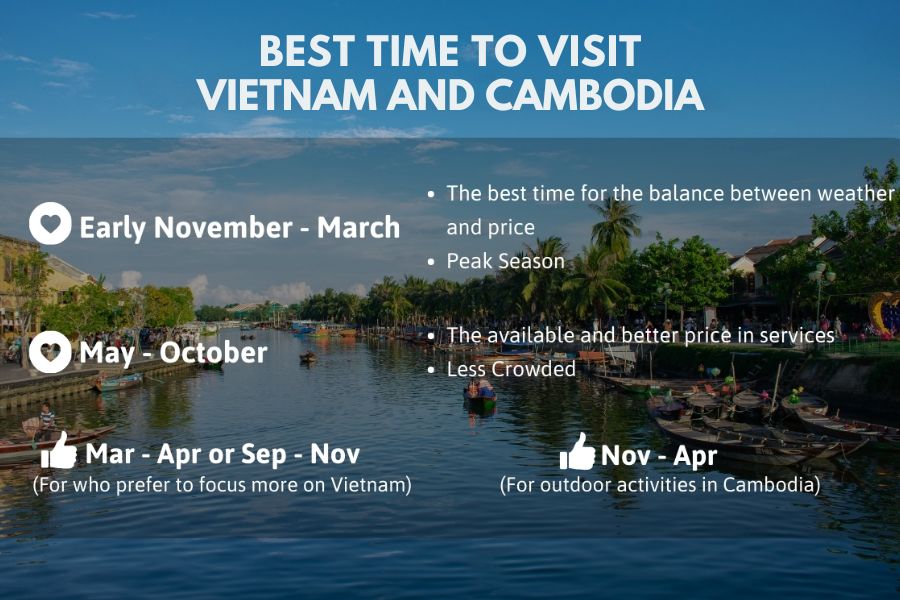
There is no single month when every part of Vietnam and Cambodia has perfect weather. Vietnam has significant regional climate differences, while Cambodia follows a clearer wet and dry seasonal pattern.
November to February
This is one of the most popular periods for a combined trip. Cambodia and southern Vietnam are generally drier, while temperatures around Angkor are more comfortable than later in spring. Northern Vietnam can be cooler, and Hanoi or Halong Bay may occasionally be misty during winter.
February to April
February and March can offer a particularly useful balance across the route. Central Vietnam generally becomes drier, Cambodia remains relatively dry and conditions in the north are often pleasant. By April, Cambodia and southern Vietnam can feel considerably hotter.
May to October
This is the greener period. Cambodia experiences its wet season, while northern and southern Vietnam also receive more summer rain. Central Vietnam follows a different pattern, with heavier rain and storm risk generally becoming more significant later in the year.
Rain does not automatically make this a poor time to travel. There are fewer visitors in some places, landscapes are greener and showers are often intermittent rather than continuous. The key is matching your dates to the regions that matter most.
If your travel dates are still flexible, our guide to the Best Time to Visit Cambodia and Vietnam compares the seasons across both countries and explains which months work best for different routes.
Planning a Vietnam and Cambodia Trip in 2026: Private Tour or Fixed Itinerary?
For Vietnam and Cambodia tours in 2026, route planning matters more than simply choosing a departure date.
Start with the flights. A multi-city ticket can make more sense than returning to the same airport. For example, flying into Hanoi and departing from Siem Reap can remove unnecessary backtracking. Domestic flights are also useful in Vietnam, but they should solve distance rather than become the itinerary itself.
Visa and entry requirements are separate for Vietnam and Cambodia and depend on nationality. If your journey includes a land or river border crossing, confirm that your intended entry method and border point are compatible with your documentation before making non-refundable arrangements.
Beyond the practical details, one of the biggest decisions is whether to choose a fixed group itinerary or private travel.
|
Private itinerary |
Fixed group itinerary |
|
Flexible pace |
Fixed daily schedule |
|
Choose hotel style |
Predetermined hotels |
|
Adjust the number of nights |
Set number of nights |
|
Easier for families and seniors |
Often lower per-person cost |
|
Private transfers |
Shared transport |
|
More room for free time |
Group sightseeing timetable |
|
Easier to change interests |
Fixed sightseeing program |
When Private Travel Works Best
Vietnam and Cambodia private tours are particularly useful when:
- you are traveling as a couple or family;
- several generations are traveling together;
- you prefer fewer early starts;
- particular hotel styles matter;
- you want to include a Mekong cruise;
- you are flying into one city and departing from another;
- you want extra free time;
- you would rather spend three nights in one destination and skip another.
The value of a private itinerary is not simply having a private vehicle. It is being able to decide how long you spend in each place. A family with children may need pool time and shorter sightseeing days. A couple may prefer more evenings free for restaurants. Senior travelers may want later departures and longer hotel stays. Those changes can make exactly the same destinations feel like a very different holiday.
When a Fixed Itinerary Works Well
A fixed tour can still be the better choice if:
- budget is a major priority;
- the published itinerary already matches your pace;
- fixed departure dates are convenient;
- you enjoy traveling with a group;
- you do not want to make many planning decisions.
Neither style is automatically better. The better choice is the one that matches how you actually like to travel.
FAQs About Vietnam and Cambodia Itineraries
- How many days to spend in Vietnam and Cambodia?
For most first-time visitors, allow at least 14 days. Sixteen to eighteen days gives a more comfortable balance, while three weeks works particularly well for travelers who want a slower pace or more destinations. - Is 10 days enough for Vietnam and Cambodia?
Yes, but only if you are selective. Focus on a few major destinations such as Hanoi, Halong Bay, Ho Chi Minh City and Siem Reap rather than trying to include every region. - Is 14 days enough for Vietnam and Cambodia?
Yes. Fourteen days is a good length for a first visit, especially if you concentrate on Vietnam’s major regions and finish with several days around Angkor. Current planning guides also commonly recommend around two weeks as the balanced first-trip range. - Should I spend more time in Vietnam or Cambodia?
Usually Vietnam. Its major destinations are much more geographically spread out, while Cambodia’s main first-time sights are more concentrated around Phnom Penh and Siem Reap. - Is it better to visit Vietnam or Cambodia first?
For many first-time visitors, starting in Hanoi and moving south before continuing into Cambodia creates the easiest geographical flow. However, flight schedules and the rest of your Southeast Asia itinerary may make the reverse direction more practical. - What is the best time to visit Vietnam and Cambodia?
November to February offers a useful overlap for Cambodia and southern Vietnam, although northern Vietnam can be cooler and Central Vietnam has its own seasonal pattern. February and March can also work very well for a broad two-country itinerary. - How many days are good for Vietnam and Cambodia tours for seniors?
Sixteen to eighteen days is a comfortable range for many senior travelers, while 21 days provides even more space between transfers and sightseeing. The ideal length depends on individual mobility, interests and preferred pace. - Are Vietnam and Cambodia private tours worth it?
They can be particularly worthwhile if flexibility matters. Private travel allows you to adjust hotel nights, departure times, sightseeing pace and transfers around your interests rather than following a fixed group schedule.
So, How Many Days Do You Really Need?
If your time is limited, 10 days can give you a good introduction, but you will need to choose your destinations carefully. 14 days is enough for a strong first trip and gives you a much better sense of both countries. 16-18 days is the range we would choose for many travelers. There is enough time for Hanoi, Halong Bay, Central Vietnam, Ho Chi Minh City, the Mekong region, Phnom Penh and Angkor without turning every day into a transfer. With 21 days, the real luxury is time. You can add places such as Ninh Binh or Hue, spend longer in Hoi An and leave room for mornings when you do not need to be in the lobby at 7:00.
For most travelers, 14 to 18 days offers the best balance between seeing enough and still having time to enjoy where you are. If you are considering Vietnam & Cambodia Private Tours, LuxeTravel Asia can design the route around your available time, preferred pace and the places that matter most to you rather than fitting every traveler into the same itinerary.
Plan Your Journey with LuxeTravel Asia and our local team can help turn the number of days you have into a Vietnam and Cambodia trip that feels comfortably paced from beginning to end.
Tags: best time to visit vietnam and cambodia, cambodia, how many days to spend in Vietnam and Cambodia, vietnam and cambodia itinerary, Vietnam and Cambodia private tours, vietnam and cambodia tours 2026, vietnam and cambodia tours for seniors, Vietnam and Cambodia trips