Laos travel tips are most useful when they help you understand how the country actually works before you arrive. Laos is relatively straightforward to explore, but distances can take longer than they appear on a map, cash is still important outside the main cities, and the best way to move between destinations often depends on the route rather than simply choosing the fastest option.
This Laos travel guide covers the practical details we most often discuss with guests before departure, from entry requirements and transport to money, internet, packing, local etiquette and Laos travel safety. Whether you are travelling to Laos for the first time or including the country in a longer Southeast Asia journey, these tips will help you plan with more confidence and fewer surprises along the way.
Laos Travel Guide at a Glance: 10 Things to Know Before You Go
If this is your first time travelling to Laos, start with these essentials:
|
What to know |
Practical advice |
|
Passport & visa |
Check the rules for your nationality and exact entry point |
|
Arrival formalities |
Digital immigration procedures apply at selected checkpoints |
|
Money |
Carry Lao kip, especially outside larger towns |
|
Transport |
The railway is useful between Vientiane, Vang Vieng and Luang Prabang |
|
Road journeys |
Travel time can be longer than the distance suggests |
|
Weather |
Pack for the season as well as altitude |
|
Temples |
Cover shoulders and knees |
|
Internet |
Mobile data is useful, but coverage drops in remote areas |
|
Safety |
Check current government travel advice before departure |
|
Pace |
Laos is usually better with fewer stops and more time in each place |
Travel expert note: The fastest transport is not automatically the best choice. On some routes, the train saves several hours; on others, a private car gives you access to countryside, villages and viewpoints that would otherwise be missed.
Travel to Laos Requirements: Passport, Visa and Arrival Formalities

Entry requirements depend on nationality, passport type and where you enter the country. For this reason, travel to Laos requirements should always be checked shortly before departure rather than relying on information from an old trip.
Passport and Visa Requirements for Laos
For travellers using the Lao eVisa system, the official requirements currently state that the passport should have at least six months’ validity from the date of arrival. The eVisa is for tourism, is valid for a single entry and allows a stay of up to 30 days.
Before travelling, check:
- Passport validity: At least six months is required for the Lao eVisa.
- Visa type: Depending on nationality, this may be visa-free entry, eVisa, visa on arrival or a visa arranged in advance.
- Length of stay: Make sure your planned itinerary fits the permitted stay.
- Entry point: Not every border crossing accepts an eVisa.
The last point is particularly important. A visa that is valid in principle is not useful if your planned railway station or land border is not one of the authorised eVisa entry points.
Lao eVisa and Entry Points
The official eVisa system currently lists designated entry points including Vientiane, Luang Prabang and Pakse international airports, selected Lao-Thai Friendship Bridges, Boten International Checkpoint and certain railway stations.
When we arrange cross-border trips, we normally check three things together:
- Which passport the traveller holds
- Which visa type applies
- The exact border or airport being used
This avoids one of the easiest mistakes to make when planning a multi-country Southeast Asia journey. It is also sensible to carry both a printed and digital copy of your eVisa approval with your travel documents.
Arrival and Departure Forms
Laos has introduced the Lao Digital Immigration Form for arrival and departure information at selected international checkpoints.
Because immigration procedures can change, our practical advice is simple:
- check the latest official procedure shortly before departure;
- complete any required digital form within the stated time frame;
- save a screenshot or PDF confirmation;
- keep your hotel address available for immigration forms.
If we are arranging the journey, we also make sure the arrival formalities match the actual route rather than treating the visa and itinerary as two separate parts of the trip.
Getting Around Laos: Trains, Private Cars, Boats and Local Transport
Transport is one of the areas where good planning has the biggest impact on the overall trip.
Laos-China Railway

For travel between Vientiane, Vang Vieng and Luang Prabang, the railway is usually the fastest option.
Advantages
- significantly shorter journey times;
- comfortable for longer intercity travel;
- particularly useful for travellers with limited time.
Things to remember
- stations can be outside the town centre;
- station transfers need to be added to the total journey time;
- security checks are part of the boarding process;
- arriving with a comfortable time buffer makes the experience far less rushed.
A published 60-minute train journey is not necessarily a 60-minute hotel-to-hotel journey. This is one of the small details we always include when planning the day.
Private Cars and Road Transfers
Private transport is particularly useful when the journey itself contains worthwhile stops. We tend to choose a private car when:
- The route passes villages or scenic areas;
- Guests want control over departure times;
- The traveller is a family or older couple who may need more rest stops;
- The destination is not well served by rail;
- The road journey is part of the experience.
We do not automatically use a private car simply because it sounds more luxurious. Between some major destinations, the train is the more comfortable and efficient option.
For us, experiential luxury means choosing the transport that makes the journey work better, not simply choosing the most expensive one.
Boats, Tuk-Tuks and Local Transport

Boats remain part of the Laos experience, especially on the Mekong and around the 4,000 Islands. Tuk-tuks are convenient for short journeys in many towns and can be an enjoyable part of local travel.
A simple rule works well:
- Short, flexible local journeys: local transport is often fine.
- Airport, train or fixed connections: pre-arranged transport is more reassuring.
- Remote routes or sightseeing days: private transport usually offers more flexibility.
Money in Laos: Lao Kip, Cards, ATMs and Everyday Payments
The local currency is the Lao kip (LAK), and cash still plays an important role in everyday travel.
Where cards usually work
Cards are more commonly accepted at:
- higher-end hotels;
- larger restaurants;
- some established shops;
- tourism businesses in Luang Prabang and Vientiane.
Where cash is still useful

Keep kip for:
- local restaurants;
- markets;
- tuk-tuks;
- smaller shops;
- rural areas;
- minor purchases and tips.
Our practical advice: withdraw cash before leaving a major town rather than assuming an ATM will be available at your next stop. This becomes particularly important on countryside or multi-day overland routes.
It is also sensible to carry more than one payment method and keep cards separately. If one card is blocked or an ATM does not accept it, another card plus some cash gives you an immediate backup.
Staying Connected in Laos: SIM Cards, Internet, Useful Apps and Power
Internet access is generally straightforward in Vientiane, Luang Prabang and other main tourist centres. Most hotels provide Wi-Fi, and mobile data is useful for maps, translations and contacting guides.
For a smoother trip, we recommend preparing a few things before leaving each main town:
- Download offline maps: Useful on rural journeys where mobile reception can weaken.
- Save your hotel address: Keep it as both text and a screenshot.
- Store guide and driver contacts: Do not rely only on messaging apps loading correctly.
- Save tickets offline: Especially rail tickets and travel confirmations.
- Carry a power bank: Helpful on full-day touring or long transfers.
- Pack a universal adaptor: Easier than relying on the sockets available in each hotel.
A very simple habit is to keep essential travel information available offline. It takes a few minutes and can be surprisingly useful when reception disappears.
What to Pack and Wear When Travelling Through Laos

Packing for Laos does not require a long specialist list. Lightweight clothes work for most of the year, with a few additions depending on the season and route.
For temples and everyday sightseeing
Bring:
- lightweight trousers or longer skirts;
- tops that can cover shoulders;
- comfortable walking shoes or sandals;
- a light scarf or overshirt;
- sun protection.
When visiting temples, shoulders and knees should be covered. Shoes are also removed in many religious spaces and private homes, so footwear that is easy to take on and off can be practical.
For northern Laos, waterfalls and the rainy season
Consider adding:
- a light layer for cool mornings;
- a compact rain jacket or umbrella;
- quick-drying clothes;
- shoes with reliable grip;
- a small dry bag;
- waterproof protection for your phone;
- insect repellent.
Travel expert note: Packing should follow the itinerary, not just the country. Someone spending five days in Luang Prabang needs different extras from someone trekking in the north or visiting waterfalls in the wet season.
Culture and Etiquette in Laos: How to Travel Respectfully
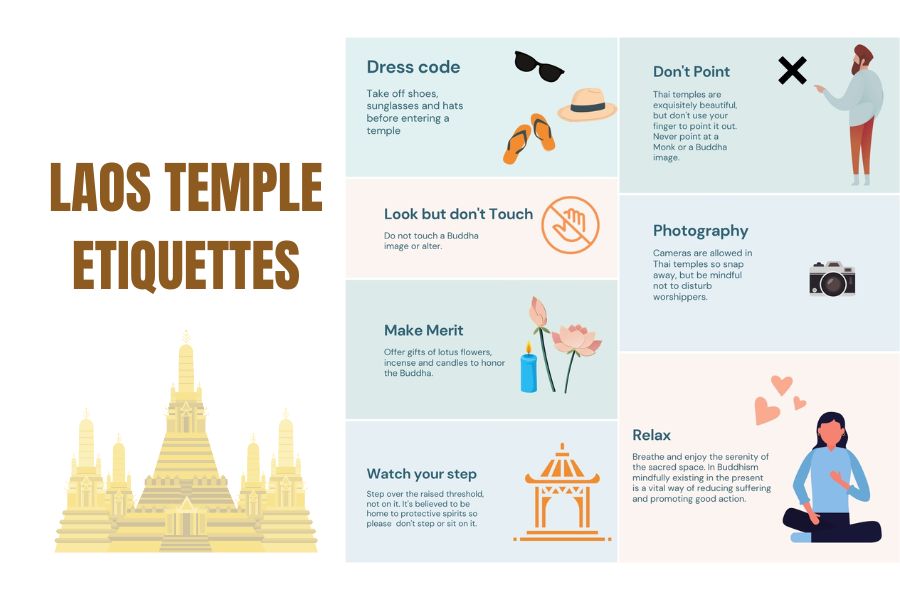
A few basic habits go a long way in Laos, especially when visiting temples or smaller communities.
Visiting Temples and Meeting Monks
Keep these points in mind:
- cover shoulders and knees;
- remove footwear where requested;
- avoid pointing your feet towards Buddha images or people;
- speak quietly during ceremonies;
- women should avoid direct physical contact with monks.
A local guide adds value here not only by explaining history, but by helping visitors understand what is happening at that moment and whether it is appropriate to observe, photograph or simply keep a respectful distance.
Photography in Villages
The rule is simple: ask before taking close photographs of people.
This is particularly important when photographing:
- children;
- monks;
- families inside their homes;
- people working in private spaces;
- ceremonies.
We are careful with village experiences because there is a difference between visiting a community and treating it as something staged for visitors.
The best interactions often happen when there is enough time for conversation and when the local guide already has a genuine relationship with the community.
Everyday Manners and Respect
Lao social culture generally values calm and polite behaviour. Useful habits include:
- avoid raising your voice during disagreements;
- do not touch people on the head;
- be conscious of where your feet are pointing;
- dress more conservatively in smaller communities;
- follow local instructions when entering homes or religious spaces.
Experiential travel does not mean turning every local moment into an organised “experience”. Sometimes respecting a place simply means knowing when to observe rather than participate.
Some Laos Travel Tips We Give Our Guests Before Arrival
These are some of the most practical Laos travel tips we share with guests:
- Do not judge travel time by distance alone: A short-looking route may include mountain roads, slower sections or worthwhile stops along the way.
- Keep Lao kip with you: Cash remains useful for smaller restaurants, markets, tuk-tuks and rural stops.
- Choose trains and private cars by route, not status: Rail can be better between major cities; private vehicles add value where the journey includes countryside and local stops.
- Allow time between railway stations and town: Station transfers and security procedures should be included in the actual journey time.
- Keep essential travel details offline: Save hotel addresses, guide contacts, tickets and passport copies where you can reach them without mobile data.
- Carry enough personal medication: Do not assume you will find the same medicine or brand in a smaller Lao town.
- Avoid tightly timed connections after rural transfers: Weather and road conditions can change, so leave a comfortable buffer before flights and trains.
- Stay on established paths in UXO-affected areas: Never touch unfamiliar objects or explore unmarked ground.
- Check visa and travel advice again before departure: Entry procedures and official safety guidance can change between booking and travel.
- Leave room in the itinerary: In our experience, an extra night in Luang Prabang or a slower countryside day usually adds more to the trip than another one-night stop.
When a Private Laos Journey Makes a Real Difference

Private travel is not necessary for every part of Laos. The railway works extremely well on some routes, and local transport can be part of the experience. With Laos private tours, the route can be adjusted around the traveller rather than forcing the traveller to follow the same fixed schedule every day.
Our Laos tours may combine private transfers with trains, boats or local transport where those options make more sense. For travellers considering Laos luxury tours, we take the same approach: luxury is not about making every service private simply because it can be.
For us, a luxury Laos journey means fewer unnecessary complications, reliable logistics, a knowledgeable local guide, well-chosen accommodation and enough time to experience each destination properly.
Sometimes the most valuable upgrade is not a more expensive hotel room. It is an extra night, a better-located property or removing a long transfer that adds little to the journey.
Frequently Asked Questions About Travelling to Laos
- Do I need a visa to travel to Laos?
It depends on your nationality and how you enter the country. Laos offers different arrangements including eVisas, visas on arrival and visa exemptions for eligible travellers. Always check the current rule for your nationality and entry point before departure. - How much cash should I carry in Laos?
There is no fixed amount that suits every traveller. ATMs are available in larger cities and cards are accepted at many higher-end hotels and restaurants, but Lao kip remains useful for smaller businesses, local food, markets and rural travel. - Is Laos safe for tourists?
Many international travellers visit Laos without serious problems, but normal precautions are important. Road conditions, methanol poisoning, petty crime and unexploded ordnance in certain areas are among the issues worth understanding before travelling. - What is the best way to travel around Laos?
It depends on the route. The Laos–China Railway is very useful between Vientiane, Vang Vieng and Luang Prabang, while private cars are better where countryside stops or flexible timing matter. Boats and local transport can also be part of the journey. - How many days do you need in Laos?
Around seven to ten days works well for a first trip focused on Luang Prabang, Vang Vieng and Vientiane. For a broader journey including northern or southern Laos, around 10 to 14 days usually creates a much more comfortable pace. - Can you use credit cards in Laos?
Yes, particularly in higher-end hotels, restaurants and established businesses in major destinations. However, cash remains important, especially outside larger towns. - Is Laos easy to combine with Vietnam, Cambodia or Thailand?
Yes. Laos works very well as part of a wider Southeast Asia itinerary, but the route should be planned around realistic flight connections, border crossings and travel times rather than simply joining capital cities together.
A Few Final Thoughts Before Travelling to Laos
The most useful Laos travel tips are often the simplest ones: check your entry requirements before departure, carry some local cash, allow realistic travel times and avoid filling every day from morning until evening. Laos is a country where a slower pace often gives you more, whether that means an unhurried morning in Luang Prabang, time to stop along a countryside road or simply staying an extra night instead of moving on too quickly.
After planning journeys across Laos and the wider region, we have found that the best itineraries are rarely the ones with the greatest number of stops. Good routing, reliable logistics, knowledgeable local guides and enough flexibility to enjoy each place usually matter far more.
If you are planning a trip to Laos, tell our local team when you would like to travel, how long you have and the experiences that interest you most. LuxeTravel Asia can design a private Laos journey around your preferred pace, with carefully chosen stays, local guides and a route that makes sense from the moment you arrive.
Tags: Laos, laos luxury tours, laos private tours, laos smart traveller, laos tours, Laos travel guide, laos travel safety, Laos travel tips, travel to laos requirements, traveling through laos, travelling to laos