Chiang Rai
Chiang Rai sits in Thailand’s far north, surrounded by mountains, farmland and communities close to the borders with Laos and Myanmar. The city is best known for striking temples such as Wat Rong Khun and Wat Rong Suea Ten, but the wider province offers much more, from tea plantations and hill country to the Mekong and the Golden Triangle. Compared with Chiang Mai, the pace is quieter and distances are greater, making Chiang Rai particularly rewarding when you have time to explore beyond the city rather than treating it as a quick temple stop.
The Character of Chiang Rai
A quieter journey through Thailand’s far north
Chiang Rai feels more provincial and less busy than Chiang Mai.
The city centre is compact, with temples, markets and cafés within easy reach, but much of what makes the destination interesting lies further into the surrounding countryside.
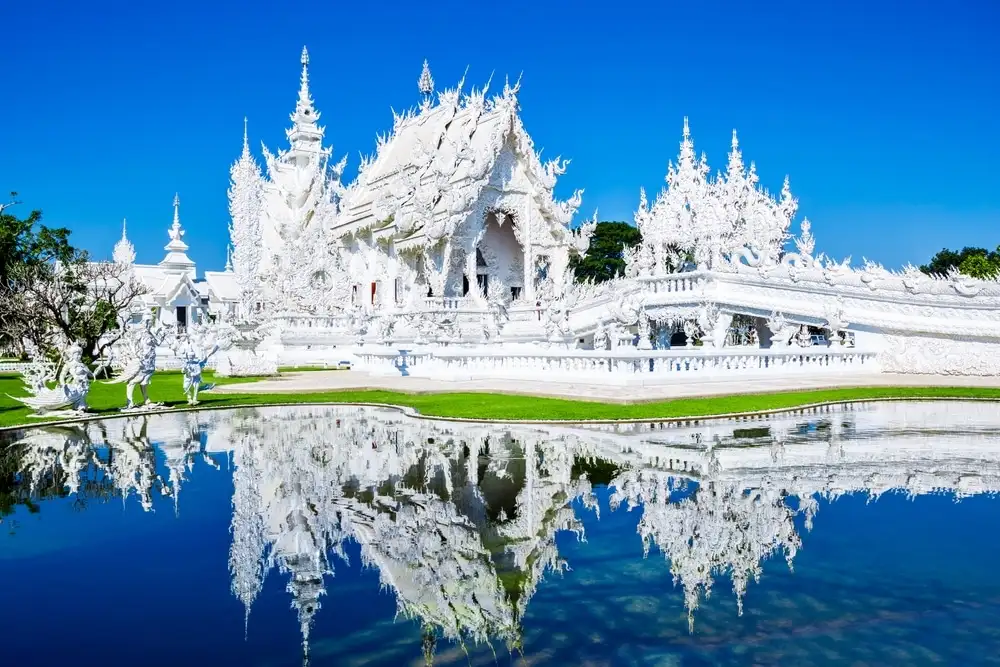
Modern temple architecture has become one of Chiang Rai’s most recognisable features. Wat Rong Khun, commonly known as the White Temple, combines Buddhist symbolism with the highly individual vision of Thai artist Chalermchai Kositpipat. Wat Rong Suea Ten, or the Blue Temple, offers an entirely different use of colour and contemporary religious art.
Travel north and the landscape changes again.
Roads climb through mountains towards Mae Salong, where tea plantations spread across the hills and Chinese cultural influences remain visible in food, language and local traditions. Around Doi Tung, gardens, forest and development projects tell another story of how the northern highlands have changed over recent decades.
Further north, the Mekong marks Thailand’s border with Laos around the Golden Triangle.
For us, Chiang Rai is less about collecting famous sights and more about the journey between them. Mountain roads, tea stops, local markets and small communities often become as important as the temples themselves.
Why Visit Chiang Rai
See a different side of Northern Thailand
Chiang Rai feels quieter and more rural than Chiang Mai, with mountains and countryside beginning close to the city.
Discover remarkable contemporary temples
The White Temple and Blue Temple show how Buddhist art and architecture continue to develop in modern Thailand.
Explore tea country
The hills around Mae Salong are home to tea plantations, small communities and some of Northern Thailand’s most enjoyable mountain roads.
Travel towards the Mekong
The Golden Triangle provides an opportunity to understand Chiang Rai’s position between Thailand, Laos and Myanmar.
Learn about the cultures of the northern highlands
The wider province is home to communities with different languages, traditions and histories connected to migration across the region.
Add depth to a Northern Thailand journey
Chiang Rai combines naturally with Chiang Mai and works particularly well for travellers who want to go further than the standard first time route.
Experiences We Love in Chiang Rai
• Visit Wat Rong Khun early in the day before continuing into the countryside.
• Explore Wat Rong Suea Ten and compare its contemporary style with Chiang Rai’s older temples.
• Spend time at Wat Phra Kaew, one of the city’s most important historic Buddhist sites.
• Travel into the hills around Mae Salong and visit a local tea producer.
• Walk through tea plantations and taste different varieties grown in Northern Thailand.
• Explore the gardens and mountain landscape around Doi Tung.
• Visit a local market while travelling through the northern countryside.
• Travel towards the Mekong and the Golden Triangle with a guide who can explain the region’s history.
• Leave time for mountain viewpoints, roadside cafés and unplanned stops along the way.
Temples of Chiang Rai
Chiang Rai’s temples range from historic monasteries to some of Thailand’s most distinctive contemporary religious buildings.
Wat Rong Khun
Wat Rong Khun, widely known as the White Temple, is unlike any traditional Thai temple.
Created by artist Chalermchai Kositpipat, the complex uses Buddhist symbolism alongside contemporary imagery and highly detailed white decoration.
It is one of Chiang Rai’s most popular sights, so visiting earlier in the day can make the experience more comfortable.
Rather than seeing it only as a photography stop, a guide can help explain some of the symbolism behind the design.
Wat Rong Suea Ten
The Blue Temple is another modern landmark, known for its rich blue interior and elaborate decorative work.
Its style is very different from Wat Rong Khun, making the two interesting to visit together.
Wat Phra Kaew
Wat Phra Kaew has a much longer history.
The temple is associated with the discovery of the Emerald Buddha, which is now housed at Wat Phra Kaew within Bangkok’s Grand Palace.
Visiting it provides useful balance after Chiang Rai’s more contemporary temples.
Mae Salong and Tea Country
Mae Salong lies in the mountains north of Chiang Rai and offers one of the most enjoyable countryside journeys in the province.
Tea plantations cover the surrounding hills, particularly varieties of oolong influenced by Chinese tea traditions.
The area also has a distinctive history connected with Chinese communities who settled here during the twentieth century.
Today, Chinese and Northern Thai influences can be seen in the food, architecture and local businesses.
A visit can include a tea plantation, tasting with a local producer, mountain viewpoints and lunch in town.
We prefer to give Mae Salong enough time rather than turning it into one of several rapid stops on a long northern day.
Doi Tung
Doi Tung lies close to Thailand’s northern border and combines mountain scenery, gardens and recent social history.
The Doi Tung Development Project has played an important role in creating alternative livelihoods in an area once associated with opium cultivation.
Visitors can explore the Mae Fah Luang Garden and nearby sites while learning more about the development of the region.
The mountain setting also makes Doi Tung a pleasant contrast to the temples and city experiences of Chiang Rai.
It can be combined with other northern areas, although we avoid putting too many distant places into the same day.
The Golden Triangle
The Golden Triangle is the area where Thailand, Laos and Myanmar meet around the Mekong River.
For much of the twentieth century, the wider region became strongly associated with the opium trade, although its history and cultural connections are far more complex than that single story.
Today, viewpoints overlook the Mekong and the neighbouring countries, while museums provide context for the history of trade and opium production in the region.
The Golden Triangle is worth visiting when it forms part of a wider exploration of Northern Chiang Rai.
We do not see it as a destination that needs to be visited simply for a photograph at the border marker.
Highland Communities and Responsible Visits
Chiang Rai province is home to communities including Akha, Lahu, Hmong, Karen and other groups with different languages, histories and traditions.
Community visits require care.
We avoid attractions where people are treated primarily as objects for photographs or where cultural identity is presented as a performance for visitors.
Where village experiences are included, we favour responsible local partners who provide context, work directly with communities and allow interaction to happen respectfully.
For travellers particularly interested in culture, a well planned visit can provide valuable insight into the diversity of Northern Thailand.
The Flavours of Chiang Rai
Chiang Rai shares many of the flavours of Northern Thailand while also reflecting influences from the mountains and nearby borders.
Khao soi, grilled meats, northern chilli dips and local sausages are widely available.
In areas such as Mae Salong, Chinese influenced dishes appear alongside Northern Thai cooking.
Tea also deserves its own place in the experience. Visiting a local producer and tasting tea where it is grown offers a very different side of Northern Thailand from the coffee and market culture of the cities.
The night bazaar and local markets in Chiang Rai provide easy opportunities to try simple dishes without turning every meal into a formal experience.
Best Time to Visit Chiang Rai
November to February generally brings cooler, drier weather and is one of the most comfortable periods for exploring Chiang Rai and the surrounding mountains.
Mornings and evenings can feel surprisingly cool in higher areas.
March and April become hotter and can also experience haze from seasonal burning across Northern Thailand.
May to October is the wetter season. The countryside becomes greener and mountain scenery can be particularly attractive, although rain may affect some outdoor activities.
For journeys into the highlands, we keep the program flexible according to visibility and road conditions.
How Long to Stay
For most travellers, two to three nights works well.
Two nights allows time for Chiang Rai’s main temples and one journey into the surrounding countryside.
Three nights provides a much better pace if you want to include Mae Salong, Doi Tung or the Golden Triangle without spending entire days rushing between distant stops.
Travellers particularly interested in mountain scenery, local culture or photography can comfortably stay longer.
Where to Stay
Chiang Rai offers both central hotels and quieter properties outside the city.
Central Chiang Rai
Staying close to the centre gives easy access to markets, restaurants and evening activities.
This works well for shorter stays.
Riverside
Several properties along the Kok River provide more space and a quieter atmosphere while remaining close to the city.
Countryside and Mountain Stays
Travellers spending longer in the province may prefer a lodge or resort outside Chiang Rai, particularly when the focus is on tea country or the northern mountains.
For LuxeTravel Asia journeys, we choose the location according to the route and experiences planned rather than automatically keeping every night in the city.
Chiang Rai With LuxeTravel Asia
Chiang Rai is a destination where route planning matters.
Mae Salong, Doi Tung and the Golden Triangle lie in different directions, and trying to include everything in a single day can result in spending more time in the vehicle than experiencing the places themselves.
We prefer to choose one area and explore it properly.
A day might combine Chiang Rai’s temples with a relaxed afternoon in the city. Another could be dedicated to Mae Salong, with time for tea, mountain scenery and local food.
Travellers particularly interested in history may prefer Doi Tung and the Golden Triangle, while those who value culture and landscape might spend more time in smaller communities and the highlands.
Private transportation allows us to stop along the way and adjust the route without following a fixed group schedule.
Chiang Rai is most rewarding when the road north becomes part of the experience rather than simply the distance between attractions.
Continue Your Journey
Chiang Rai combines naturally with Chiang Mai, creating a journey through Northern Thailand that moves from Lanna culture and city life into quieter mountain country.
From the far north, travelers can also continue towards the Mekong and Laos, making Chiang Rai a useful part of a wider journey connecting Thailand with Luang Prabang.
Alternatively, return to Bangkok or fly south for a beach stay in Phuket, Krabi, Koh Samui or other parts of Thailand.
Explore All Our Tours
Explore Thailand’s best, from lively cities and historic temples to tropical islands and northern landscapes.
No tours found.