Xieng Khouang
Xieng Khouang is a highland province in northeastern Laos, best known for the Plain of Jars, where thousands of large stone vessels are scattered across fields and hills. Their exact purpose remains uncertain, although archaeological research links them to ancient burial practices dating back more than two thousand years. Beyond the jar sites, the province offers rolling countryside, Hmong and other ethnic communities, local markets and important reminders of the conflict that affected this part of Laos during the twentieth century. For travelers interested in archaeology, history and less visited parts of the country, Xieng Khouang offers a very different experience from Luang Prabang or Vang Vieng.
The Character of Xieng Khouang
Ancient mysteries across the Lao highlands
Xieng Khouang feels open and spacious, with broad grasslands, low mountains and farming communities spread across the plateau.
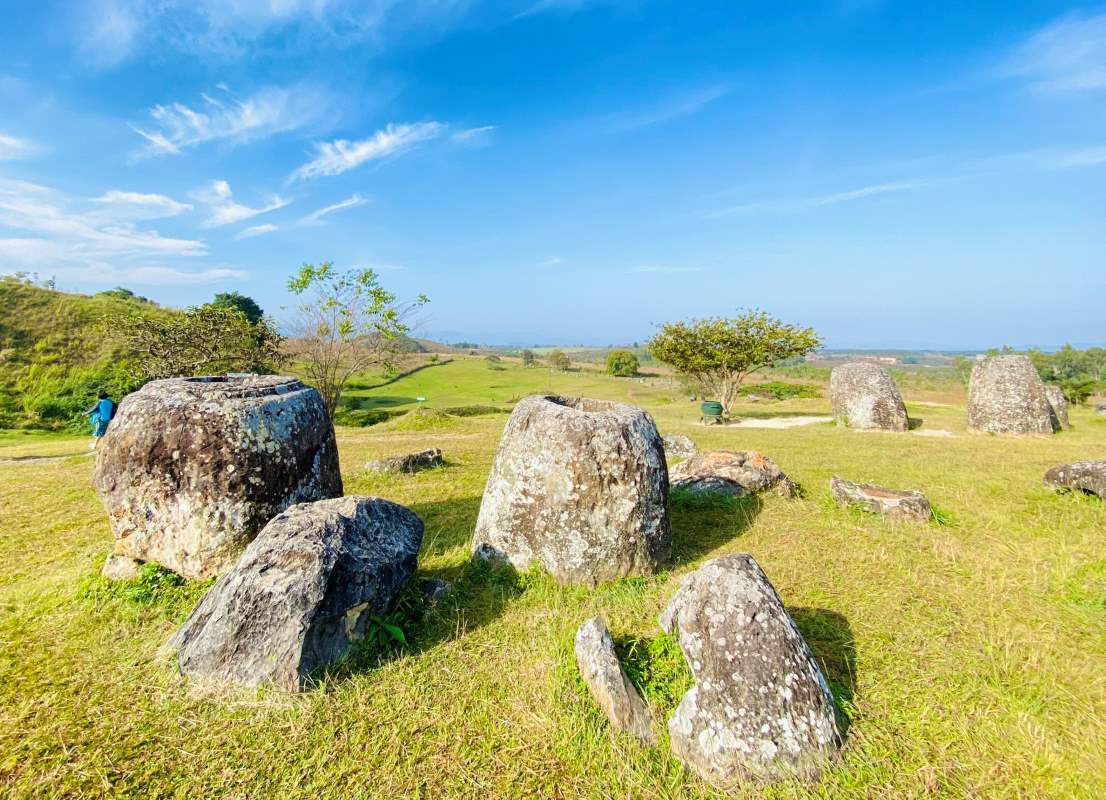
The Plain of Jars is the main reason travelers come here. Across several archaeological sites, large stone jars sit individually or in groups, some standing upright while others have fallen or become partly covered by the surrounding landscape.
Much about them remains uncertain. Archaeologists have studied the jars for decades, but questions about exactly how they were made, transported and used continue to make the sites fascinating.
The province also carries a much more recent history. Xieng Khouang was heavily affected by bombing during the conflicts of the twentieth century, and unexploded ordnance remains a serious issue in parts of the countryside today. Museums and local organisations provide important context for understanding how this history continues to affect communities.
Travelling here is therefore about more than archaeology. Ancient sites, modern history and rural life sit side by side across the highlands.
Why Visit Xieng Khouang
Explore the Plain of Jars
The ancient stone jars are unlike anything else in Laos and remain one of the country’s most intriguing archaeological sites.
Discover a less visited region
Xieng Khouang receives far fewer visitors than Luang Prabang or Vang Vieng, offering a quieter look at life in the Lao highlands.
Understand Laos’ recent history
The province provides important insight into the impact of war and unexploded ordnance on rural communities.
Experience the northern highlands
Rolling hills, farmland and villages give Xieng Khouang a completely different landscape from the Mekong valley.
Learn about local cultures
Hmong and other ethnic communities live throughout the province, adding another layer to the cultural character of the region.
Experiences We Love in Xieng Khouang
• Explore the main Plain of Jars sites with a knowledgeable local guide.
• Walk among the stone jars while learning about current archaeological research.
• Visit the local museum for context before exploring the archaeological landscape.
• Learn about the impact of unexploded ordnance and the work being done to make rural areas safer.
• Travel through the highland countryside between Phonsavan and the jar sites.
• Visit local villages and markets when they fit naturally into the journey.
• Explore the ruins of the former provincial capital at Muang Khoun.
Exploring the Plain of Jars
The Plain of Jars is spread across numerous archaeological locations rather than one single site.
Site 1
Site 1 is the largest and most accessible of the main jar fields.
Hundreds of jars are spread across open grassland close to Phonsavan, making it a good starting point for understanding the scale and history of the archaeological area.
Site 2
Site 2 has a more rural setting, with jars positioned across low hills and beneath trees.
The landscape feels noticeably different from Site 1 and offers wider views across the surrounding countryside.
Site 3
Site 3 requires a short walk through farmland and rice fields before reaching the jars.
Its smaller scale and rural approach often make it one of the most enjoyable sites for travellers who have enough time to explore beyond the main field.
We generally recommend visiting two or three sites rather than trying to cover as many locations as possible.
Muang Khoun
Muang Khoun was once the capital of the former Xieng Khouang kingdom.
Much of the town was destroyed during the conflicts of the twentieth century, but several old religious structures and ruins remain.
A visit provides useful context for the province beyond the Plain of Jars and shows another side of its long and often difficult history.
Muang Khoun can be combined naturally with countryside stops as part of a full day from Phonsavan.
Understanding the Legacy of War
Xieng Khouang was one of the most heavily bombed areas of Laos during the conflict in Indochina.
Unexploded ordnance still affects agriculture, construction and everyday life in some rural areas.
Visitors should remain on marked paths at archaeological sites and follow local guidance when walking in the countryside.
Museums and organisations in Phonsavan explain both the history of the bombing and the continuing work to clear unexploded ordnance.
We believe this context is important. It helps travellers understand the province as it is today rather than seeing the Plain of Jars only as an isolated archaeological attraction.
Best Time to Visit Xieng Khouang
November to February generally brings cooler and drier conditions and is one of the most comfortable periods for exploring the jar sites.
March to May becomes warmer, although mornings can still be pleasant for outdoor visits.
June to October is the wetter season, when the surrounding countryside becomes greener but paths may be muddy after heavy rain.
Because Xieng Khouang sits at higher elevation, mornings and evenings can feel considerably cooler than in Vientiane.
How Long to Stay
For most travellers, two nights works well.
This gives one full day to explore several Plain of Jars sites and additional time for Muang Khoun, museums or the surrounding countryside.
Three nights is worthwhile for travellers with a strong interest in archaeology, local history or rural experiences.
Where to Stay
Most visitors stay in Phonsavan, the provincial capital and the main base for exploring the Plain of Jars.
Accommodation is generally simpler than in Luang Prabang or Vientiane, with a selection of comfortable local hotels and small guesthouses.
For LuxeTravel Asia journeys, we prioritise cleanliness, location, reliable service and access to the archaeological sites rather than hotel category.
Xieng Khouang With LuxeTravel Asia
Xieng Khouang is a destination where a good local guide adds considerable value.
The stone jars are fascinating to see, but the experience becomes much more meaningful when their archaeological context, local history and surrounding landscape are understood together.
We usually combine two or three jar sites rather than rushing between every available location. Time can then be added for Muang Khoun, a local market or a museum depending on your interests.
We also take the province’s unexploded ordnance history seriously and use established routes and responsible local partners when travelling through rural areas.
Xieng Khouang is not about ticking off another major attraction. It is a place for travellers who want to understand a more complex side of Laos.
Continue Your Journey
Xieng Khouang can be combined with Luang Prabang, creating a journey from the cultural heart of northern Laos into the highland landscapes around the Plain of Jars.
It also fits naturally into longer overland journeys through northeastern Laos for travellers who want to explore beyond the country’s main tourism route.
For most first time visitors, we recommend including Xieng Khouang when there is enough time to travel slowly rather than squeezing it into an already busy itinerary.
Explore All Our Tours
Find the Laos journey that suits your interests, pace and way of travelling.
No tours found.